How HVAC Replacement Backlog Affects Your Sale Price
You've got six weeks of installs on the calendar. Crews are booked. Equipment is ordered. Cash is coming.
Here's the question nobody asks until it's too late: does that backlog actually show up in your sale price?
It should. But for most DFW HVAC owners, it doesn't, at least not fully. And the reason is almost always documentation, not the deals themselves.
Let's fix that.
Why Backlog Matters to a Buyer
When a qualified buyer, whether that's a private equity-backed platform, an independent operator, or an SBA borrower, underwrites your HVAC business, they're buying a future cash flow stream. Not just history. History is the floor. Backlog is the ceiling.
A sold replacement job represents three things a buyer loves: a signed contract, a committed homeowner or commercial client, and revenue that doesn't require a single marketing dollar to generate.
In a market like Dallas-Fort Worth, where the construction boom never really ended and the summer heat makes emergency replacements a near-daily event, a healthy backlog signals that the business has demand the current owner can't fully service alone. That's a growth story. And growth stories command higher multiples.
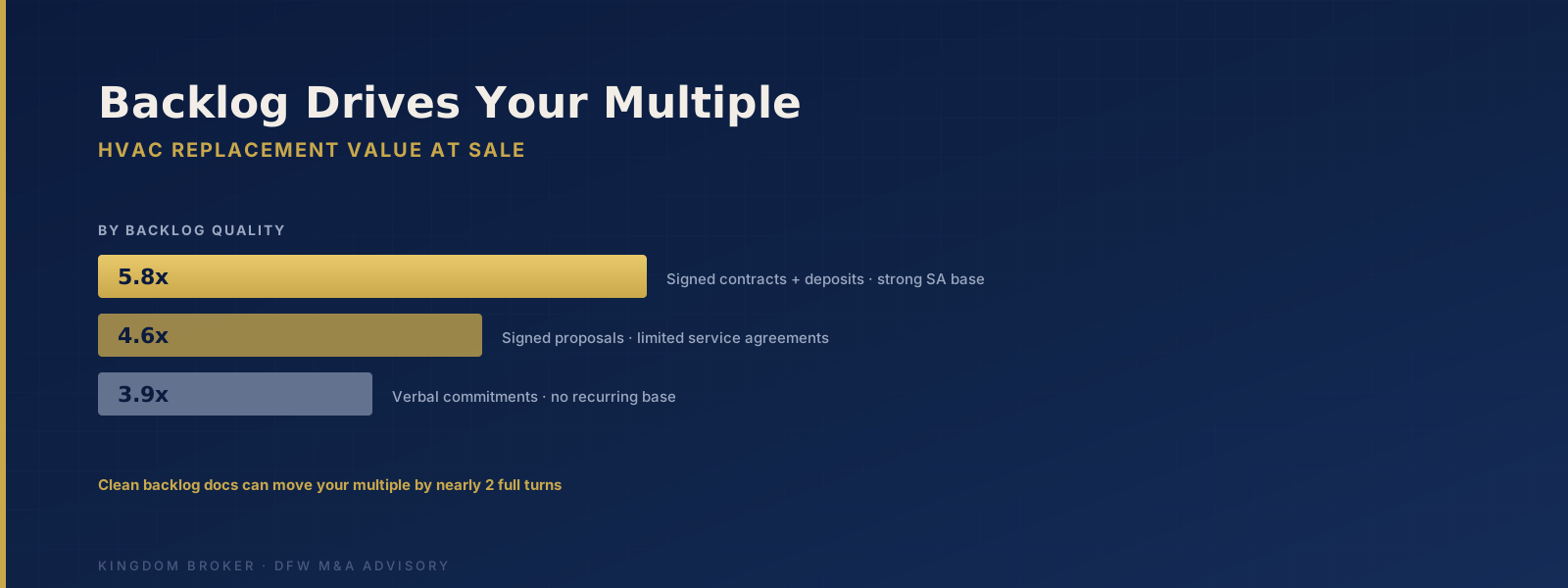
We've seen HVAC businesses in the $1.5M-$4M EBITDA range trade at meaningfully different multiples based almost entirely on how the backlog was presented. Same revenue. Same margins. Totally different outcomes at the closing table.
What Buyers Actually Count as Backlog
Not all booked work is created equal in a buyer's eyes. Here's how they typically tier it:
- Signed contracts with deposits collected: This is gold. Revenue is recognized, customer is committed, cancellation risk is low.
- Signed proposals, no deposit yet: Still valuable, but buyers will haircut it 15-25% for fallout risk.
- Verbal commitments or "we're going to move forward": Buyers don't count this. You shouldn't either.
- Maintenance contract renewals driving replacement leads: Underwriting gold if you can show the conversion rate from your service agreement base.
The cleaner the documentation, the less a buyer discounts it. That's really the whole game.
How to Document Backlog Before You Go to Market
If you're thinking about selling in the next 12-24 months, start building your backlog report now. You want a living document, updated weekly, that shows:
- Customer name and address
- Equipment type and unit cost
- Signed contract date
- Deposit amount collected
- Scheduled install date (or estimated install window)
- Gross revenue and estimated gross margin per job
Run this out of your field management software: ServiceTitan, Successware, or even a clean Excel sheet. The format matters less than the consistency. Buyers want to see that you track this as a real operating metric, not something you assembled the week before LOI.
If you've been sloppy about this, don't panic. A good broker can help you reconstruct three to six months of backlog history from your invoicing system. It's not ideal, but it's workable. The goal is showing a pattern, not just a snapshot.
Read more about preparing your books and records in our full guide on how to prepare your business for sale.
The Multiple Math: How Backlog Shifts the Number
Here's where it gets concrete.
A typical DFW HVAC business with $1M-$3M in EBITDA trades somewhere in the 4x-6x range depending on margin quality, owner dependency, and customer concentration. That's a wide range. Backlog is one of the real levers that moves you toward the top of it.
Think about it from the buyer's perspective. They're paying, say, $6M for your business. If you've got $800K in signed replacement contracts already on the calendar for the next 90 days, that's not hypothetical future revenue, that's money already sold. A smart buyer will give you credit for it in the form of a higher multiple or a working capital adjustment at close.
We've seen sellers leave $200K-$500K on the table simply because they couldn't produce a clean backlog report during due diligence. The buyer didn't doubt the work existed. They just couldn't underwrite what they couldn't verify.
That's a painful haircut for a problem that takes about four hours to fix.
If you want to understand how buyers think about quality of earnings and add-backs alongside backlog, our quality of earnings guide for DFW businesses is worth a read. And if you're not sure what your HVAC business is actually worth right now, start with our HVAC business valuation breakdown.
Replacement vs. Service: Why the Mix Matters
Not all backlog is equal from a risk standpoint either. Buyers pay close attention to the split between replacement revenue and service/maintenance revenue.
Replacement is higher ticket. Great for cash flow. But it's also more episodic, homeowners don't replace units every year. If your backlog is 90% new installs with no recurring service agreement base underneath it, buyers will model the revenue as lumpy and discount accordingly.
The ideal story for a DFW HVAC seller going to market is a strong replacement backlog sitting on top of a sticky maintenance contract base. The contracts provide predictability. The backlog provides near-term certainty. Together they make a compelling underwriting case.
If you haven't built out your service agreement program yet, it's not too late, but know that it takes 12-18 months of consistent selling to show up meaningfully in your financials before a sale.
Common Mistakes HVAC Owners Make With Backlog
We see the same errors over and over in this market. Avoid them.
- Counting verbal commitments as real backlog in your pitch deck
- Presenting backlog by job count instead of revenue, buyers think in dollars
- Not separating commercial backlog from residential (buyers underwrite them differently)
- Failing to show historical backlog conversion rates, if 95% of signed proposals close, prove it
- Waiting until you're under LOI to pull the data together
Owner dependency is a related issue that often surfaces during backlog review. If the reason jobs are getting booked is you, your relationships, your sales calls, your reputation, buyers will worry about what happens after you leave. We wrote about this directly in our post on how owner dependency kills business value. Worth reading before you go to market.
The DFW Advantage, and Why It Cuts Both Ways
Dallas-Fort Worth is one of the best HVAC markets in the country. Population growth, extreme summers, aging housing stock in established suburbs like Garland, Mesquite, and Arlington, demand is structural, not cyclical.
That's a real tailwind for valuation. Buyers know it. PE-backed platforms are actively acquiring in this market right now because they see the long-term thesis clearly.
But here's the flip side: because DFW HVAC businesses are in demand, the buyers underwriting them are sophisticated. They're not going to take your word for a $600K backlog. They want the data. They want the contracts. They want the deposit history.
The market gives you leverage. Don't waste it with sloppy paperwork.
If you're thinking about the full process of selling your HVAC business in DFW, our dedicated guide on how to sell your HVAC business in Dallas-Fort Worth walks through every stage from valuation to close.
When to Bring in a Broker
The best time to talk to an advisor is before the backlog conversation becomes urgent. If you're 18-24 months from a potential sale, there's still time to build the documentation habits that translate directly into a higher number at the table.
If you're 6 months out, you need someone in your corner immediately, not to rush the process, but to make sure the backlog story is framed correctly before buyers start asking questions.
At Kingdom Broker, we work exclusively with DFW home and commercial service businesses in the $1M-$20M range. We know how buyers in this market think about HVAC backlog, and we know how to present it so it lands. Start with a free business valuation and we'll show you where you stand today.
Find Out What Your Backlog Is Worth at Closing
Get a free valuation from Kingdom Broker and see exactly how your replacement backlog and service mix translate into a real sale price, before you talk to a single buyer.
Get Your Free Valuation