Why HVAC Businesses Are in High Demand Right Now
The HVAC industry is one of the most active sectors in business acquisitions right now, and for good reason. Every home, office building, hospital, and warehouse needs climate control. That demand does not go away in a recession, and it does not get disrupted by a software startup. Buyers, from private equity firms to search fund operators to first-time acquirers using SBA financing, are actively looking for well-run HVAC businesses in the $1M to $20M revenue range.
What makes HVAC businesses so attractive to acquirers? Three things stand out above the rest. First, the industry generates recurring revenue through maintenance contracts and service agreements, the kind of predictable cash flow that buyers pay a premium for. Second, HVAC businesses serve an essential, non-discretionary need, when someone's air conditioning goes out in July, they are not comparison shopping for three weeks. Third, the industry is highly fragmented, meaning there are thousands of well-run independent shops that can be acquired and consolidated into larger platforms.
For owners who built their HVAC company over 15, 20, or 30 years of early mornings and late-night emergency calls, this is a favorable market to be selling into. But favorable conditions only matter if you know your number and you present the business the way a buyer needs to see it.
$171B
U.S. HVAC market size in 2025, and growing at 6% annually
3.5-6.0x
typical EBITDA multiple range for HVAC businesses ($1M-$20M revenue)
70%+
of HVAC business owners are within 10 years of retirement
The combination of aging ownership, strong buyer demand, and favorable financing conditions creates a window that will not stay open forever. As more private equity firms enter the space and build regional HVAC platforms, the businesses that go to market well-prepared will command the strongest prices.
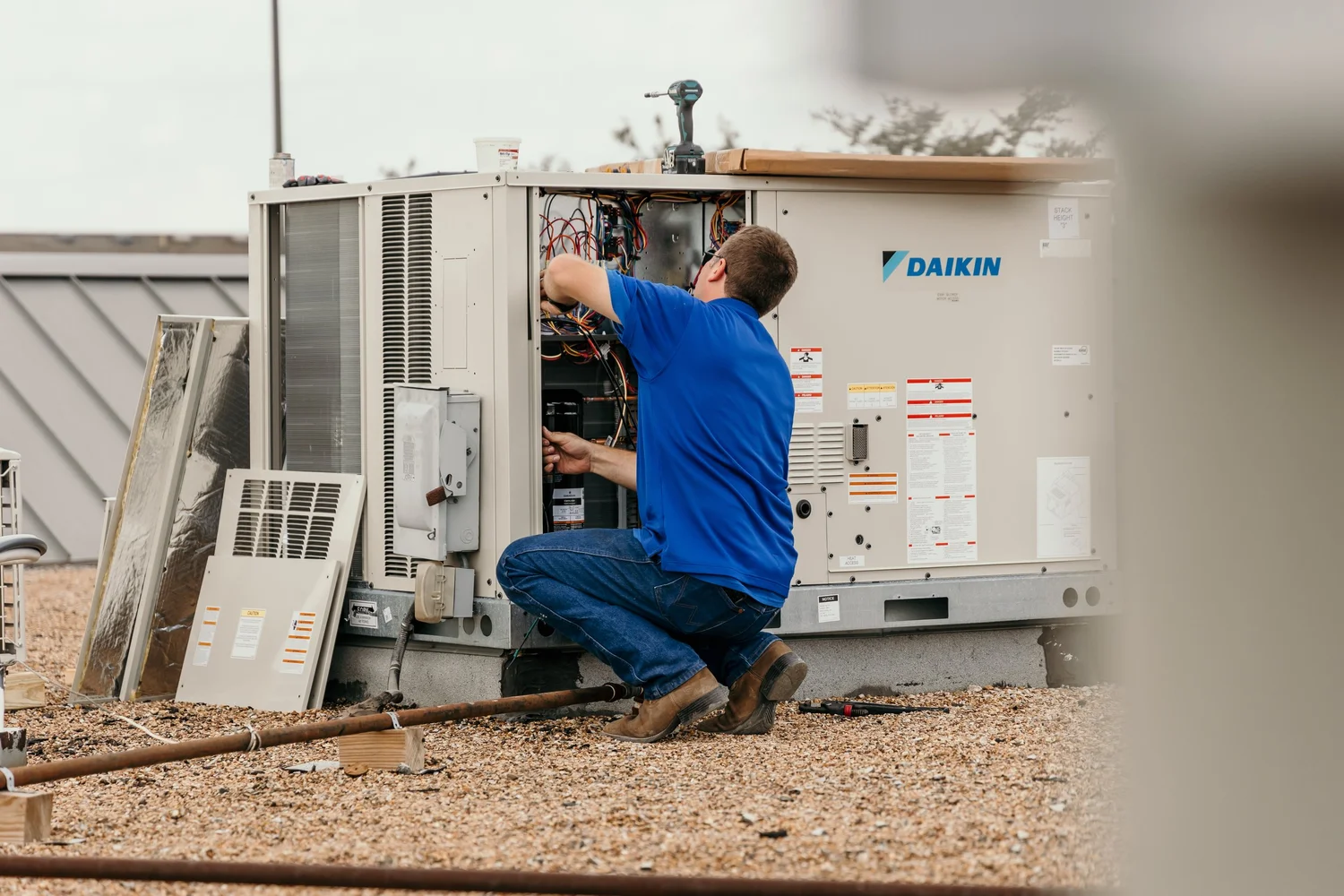 Commercial HVAC
 Residential Service
 Skilled Trades
HVAC Business EBITDA Multiples: What Buyers Actually Pay
The most common way buyers value an HVAC business is by applying a multiple to the company's adjusted EBITDA, that is, earnings before interest, taxes, depreciation, and amortization, with add-backs for owner-specific expenses that a new owner would not incur. Understanding the multiple range for your size and type of HVAC business is the foundation of knowing what your company is worth.
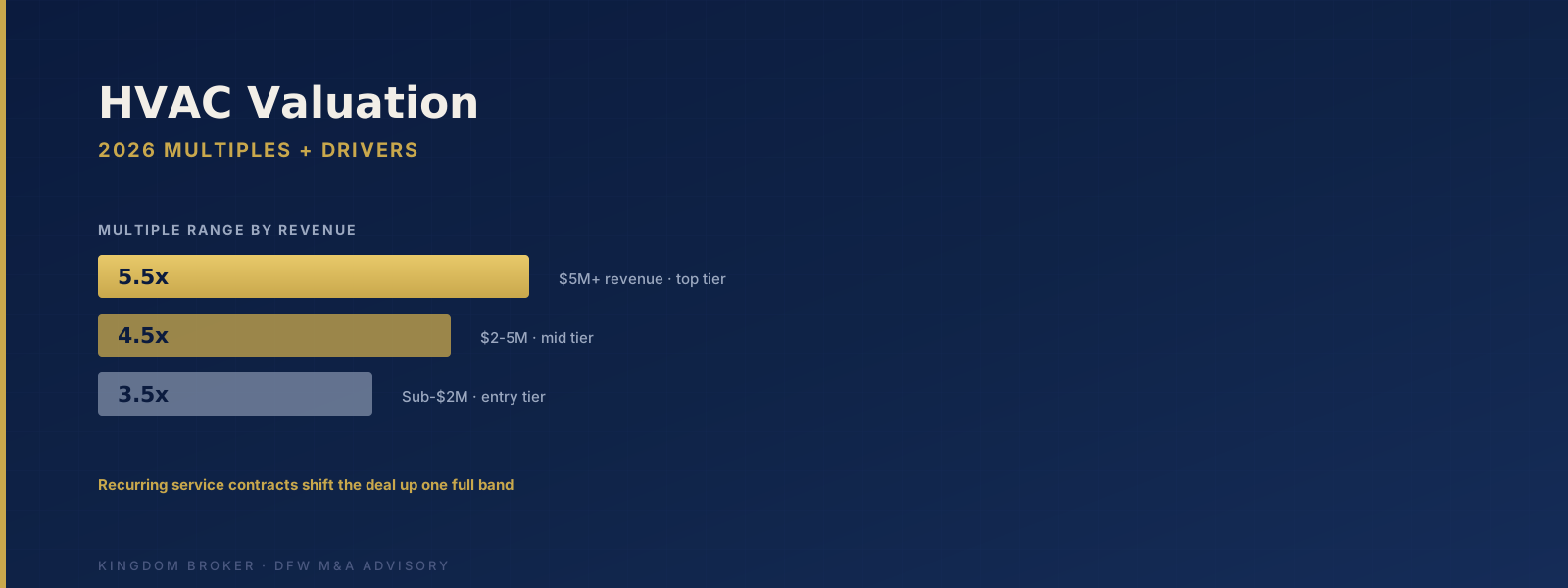
HVAC EBITDA multiples vary based on several factors: the size of the business, the percentage of revenue that is recurring, the strength of the management team, geographic market, and growth trajectory. Here is how the ranges typically break down based on industry benchmarks and closed transactions:
These ranges are based on industry benchmarks from completed transactions in 2024 and 2025. Keep in mind that multiples are applied to normalized EBITDA, not the raw number on your tax return. That is where add-backs come in, and understanding them can mean a difference of hundreds of thousands of dollars in your valuation. More on that below.
"The difference between a 3.5x and a 5.0x multiple on an HVAC business doing $800K in EBITDA is $1.2 million. Preparation and positioning are not optional, they are your biggest payday lever."
The 6 Factors That Drive HVAC Business Value
Not every HVAC company doing $5M in revenue will sell for the same price. The multiple a buyer is willing to pay depends on a set of value drivers that signal how risky or how attractive your business is as an investment. Understanding these drivers is the difference between leaving money on the table and commanding a premium.
🔄
Recurring Revenue from Service Agreements
Maintenance contracts and service agreements create predictable, repeatable cash flow. Buyers pay a significant premium when 30-50% or more of revenue is recurring. This is the single most important value driver in HVAC valuations.
👥
Management Team Independence
If the business depends on the owner for everything, sales, estimates, customer relationships, hiring, that is a risk to the buyer. Businesses with a strong operations manager, lead techs, and office staff who can run day-to-day operations without the owner sell for higher multiples and close faster.
📈
Revenue Growth Trend
Consistent year-over-year revenue growth signals a healthy market position and growing demand. HVAC businesses showing 8-15% annual growth over 3 years are especially attractive. Flat or declining revenue requires explanation and usually results in a lower multiple.
📊
Clean, Verifiable Financials
Three years of clean tax returns, P&L statements, and bank statements that tell a consistent story. When the numbers on the tax returns match the P&Ls and the bank deposits confirm the revenue, buyers gain confidence, and confidence translates to a higher price.
🏗️
Diversified Customer Base
If 40% or more of your revenue comes from a single customer or general contractor, that is concentration risk. Buyers want to see that no single customer accounts for more than 10-15% of revenue. A mix of residential and commercial work also adds stability.
📍
Strong Local Market Position
Brand recognition, Google reviews, and a reputation for reliability in a growing metro area all contribute to value. HVAC businesses in high-growth Sun Belt markets: Texas, Florida, Arizona, the Carolinas, tend to attract more buyer interest and higher valuations.
HVAC Business Valuation: A Real-World Walk-Through
To make this concrete, here is how a typical HVAC business valuation works in practice. Consider a fictional company we will call DFW Comfort Systems, a residential and light commercial HVAC company in the Dallas-Fort Worth area.
Example: DFW Comfort Systems: Dallas, TX
Revenue (TTM): $4.2M | Reported EBITDA: $620K | Years in Business: 22
Owner Comp: $280K (market rate for GM: $130K) | Personal Vehicles: $42K/yr | Family Member (Non-Working): $55K/yr
Service Agreement Revenue: 35% of total | Employee Count: 18 | Strong Ops Manager: Yes
Step 1: Calculate Normalized EBITDA
Start with reported EBITDA of $620,000. Then add back the owner-specific expenses a new owner would not incur:
- Excess owner compensation: $280K - $130K = $150,000 add-back
- Personal vehicle expenses: $42,000 add-back
- Non-working family member salary: $55,000 add-back
Normalized EBITDA: $620K + $150K + $42K + $55K = $867,000
Step 2: Apply the Multiple
DFW Comfort Systems has 35% recurring revenue, a capable ops manager, 22 years in business, and is located in a strong growth market. Based on the comparable range for HVAC companies in the $2M-$5M revenue tier with these characteristics, a reasonable multiple range is 3.5x to 4.5x normalized EBITDA.
- Low estimate: $867K × 3.5 = $3,035,000
- Mid estimate: $867K × 4.0 = $3,468,000
- High estimate: $867K × 4.5 = $3,902,000
That is a valuation range of approximately $3.0M to $3.9M. Without the add-backs, the same company at the same multiples would have been valued at $2.17M to $2.79M, a difference of nearly $1 million. This is why understanding your normalized EBITDA matters so much.
Want to run your own numbers? Our free HVAC business valuation tool walks you through this exact process with real industry multiples, and it takes less than three minutes. No login required.
How HVAC Business Sales Are Structured
Knowing your valuation is important, but understanding how the deal actually gets structured determines what you walk away with. The three most common deal structures for HVAC business acquisitions in the $1M-$10M range are SBA 7(a) financing, seller notes, and equity rollovers.
SBA 7(a) Financing
This is the most common structure for HVAC acquisitions under $5M. The SBA guarantees a portion of the bank loan, allowing buyers to acquire businesses with 10-20% down. For you as the seller, SBA deals are attractive because the buyer gets favorable terms (10-year amortization, competitive rates), which means they can pay a higher purchase price. The key requirement: your business needs three years of clean tax returns showing consistent cash flow. If your books are in order, positioning your deal as SBA-eligible expands your buyer pool dramatically.
Seller Notes
In many HVAC transactions, the seller carries a portion of the purchase price as a note, typically 10-20% of the total deal value, paid over 3-5 years with interest. While some owners resist this idea, a seller note can actually increase your total proceeds. It signals to the buyer (and the bank) that you have confidence in the business going forward, which can push the purchase price up. It also helps bridge any gap between what the buyer can finance and what the business is worth.
Equity Rollovers
For larger HVAC businesses being acquired by private equity firms or platform operators, you may be asked to roll over 10-30% of your equity into the new entity. This means you keep a minority ownership stake and participate in the upside if the buyer grows the business or combines it with other HVAC companies. Some HVAC owners have earned more on their second exit (the rollover payout) than they did on the initial sale. This structure works best when the buyer has a clear platform strategy and a track record of value creation.
Frequently Asked Questions About HVAC Business Valuation
What EBITDA multiple do HVAC businesses sell for?
HVAC businesses in the $1M-$20M revenue range typically sell for 3.5x to 6.0x adjusted EBITDA. Companies with strong recurring service agreements, clean financials, and a management team that can operate without the owner tend to command the higher end. Smaller owner-operated shops may trade closer to 2.5x-3.5x.
How does recurring revenue affect HVAC business value?
Recurring revenue from maintenance contracts is one of the strongest value drivers for HVAC businesses. Buyers pay a premium for predictable cash flow. An HVAC company where 30-50% of revenue comes from recurring service agreements can command 0.5x to 1.5x higher EBITDA multiples than a company that relies entirely on one-time install and repair work.
What are the most common add-backs for HVAC business valuations?
Common add-backs include above-market owner compensation, personal vehicle expenses run through the business, family members on payroll who do not perform operational roles, one-time equipment purchases, personal insurance premiums, and discretionary travel or entertainment. These add-backs increase normalized EBITDA and therefore the overall valuation.
How long does it take to sell an HVAC company?
A well-prepared HVAC business with clean financials, a solid management team, and a clear growth story can close in 90 to 180 days from listing to closing. Businesses that go to market without preparation can sit for 12 to 24 months or fail to sell entirely. Pre-sale preparation is one of the highest-ROI activities an HVAC owner can undertake.
Should I use SBA 7(a) financing when selling my HVAC business?
SBA 7(a) financing is one of the most common deal structures for HVAC acquisitions in the $1M-$5M range. It allows buyers to acquire with as little as 10-20% down, expanding your buyer pool. SBA loans require consistent cash flow and clean tax returns for at least three years. If your books are strong, structuring as SBA-eligible can help you achieve a higher price with more qualified buyers.
Know Where You Stand Before You Start the Conversation
You did not build your HVAC business overnight. You earned every customer, every five-star review, every technician who stayed because you treated them right. The valuation should reflect that, not just a number on a spreadsheet, but a clear picture of what you built and what it is worth to the right buyer.
The owners who get the best outcomes are the ones who understand their financials, know their add-backs, and go to market with a clear story. Whether you are two years from selling or ready to start conversations now, the first step is the same: know your number.
We built a free HVAC business valuation tool that uses real 2025-2026 EBITDA multiples from your industry. It takes less than three minutes, requires no login, and gives you a personalized estimate based on your actual financials, not a guess.
Free: Takes 3 Minutes
See What Your HVAC Business
Looks Like Through a Buyer's Eyes
Use real 2025-2026 EBITDA multiples from the HVAC industry. Get a personalized valuation range based on your actual financials and the value drivers that matter most.
Confidential · No obligation · Nationwide coverage