Quality of Earnings Report: Why DFW Business Owners Need One Before Selling
I have watched more DFW business owners lose money at the closing table than I care to count. Not because their business was weak. Not because the buyer was cheap. Because their numbers could not stand up to scrutiny.
A quality of earnings report fixes that. It is the single most valuable document you can put in a buyer's hands. And almost no DFW seller under $20M in revenue has one ready before they go to market. That is the gap. Here is how to close it.
What Is a Quality of Earnings Report?
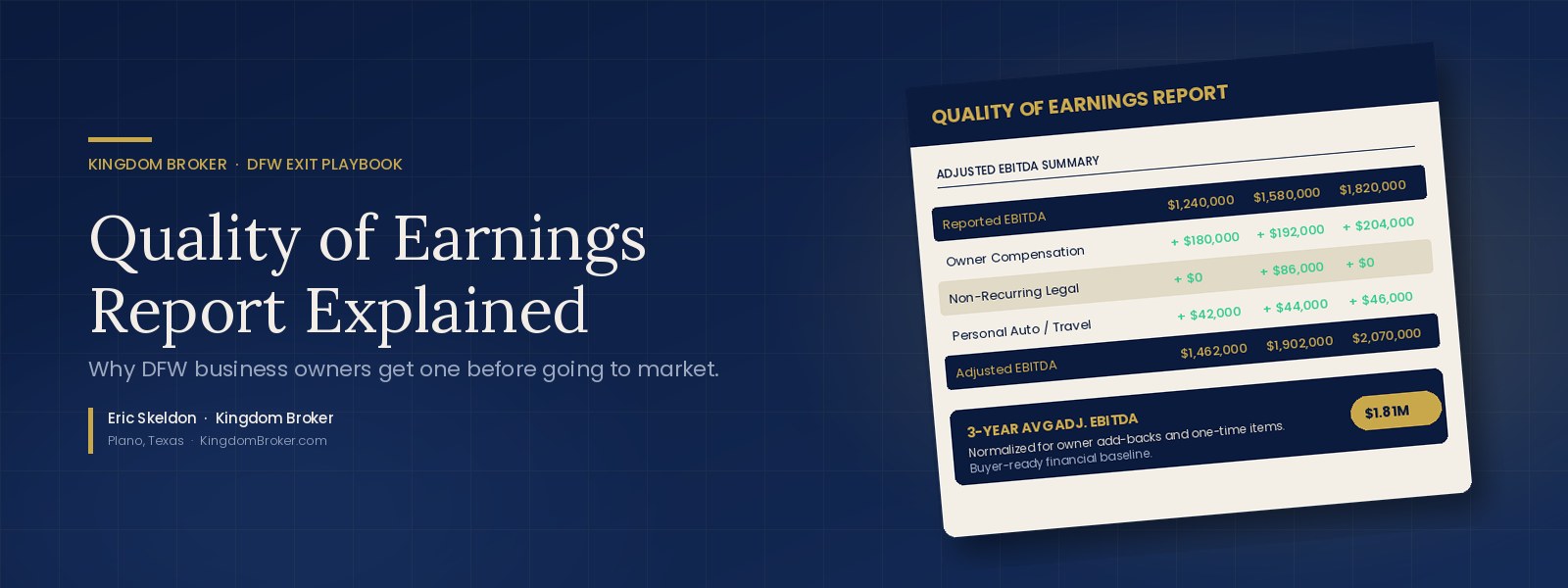
A quality of earnings report, often shortened to QofE, is a third-party financial analysis that takes your reported earnings and rebuilds them into a number a buyer will actually trust. It is not an audit. An audit confirms your books follow GAAP. A QofE goes further. It strips out the noise and shows what the business really earns.
That means adjusting for owner compensation. Adding back one-time legal fees. Pulling out the personal vehicle on the books. Normalizing inventory adjustments. Looking at revenue concentration. Testing whether your margins are real or borrowed from timing.
The output is a defensible adjusted EBITDA number. That number anchors everything. Your asking price. The buyer's offer. The lender's loan amount. The earnout terms. Every dollar in your sale flows from it.
Why a QofE Matters More Than Your Tax Returns
Most DFW owners think their tax returns and a clean P&L are enough. They are not. Tax returns are written to minimize taxes, not maximize valuation. Every legitimate deduction you took for the IRS makes your business look smaller to a buyer.
A QofE flips that. It tells the real story. Your business made more than your tax return suggests, and here is the line-by-line proof. Without it, you are asking a sophisticated buyer to take your word for it. They will not.
When You Need a Quality of Earnings Report
If your business will sell for more than about $2M, you need one. Here is who will demand it:
- SBA 7(a) lenders on deals above $1.5M almost always require a QofE before they will fund.
- Private equity buyers will not write an LOI without one, and most will commission their own if you do not have one ready.
- Family offices use QofE reports to compare opportunities and justify their investment committee.
- Strategic buyers with sophisticated finance teams will run your numbers through their own process. A QofE saves them time and you money.
- Independent sponsors need a clean QofE to raise capital from their LPs to fund the deal.
Sell-Side vs Buy-Side QofE
There are two flavors of the same report, and the difference matters.
A sell-side QofE is commissioned by you, the seller, before going to market. You control the timeline. You see every adjustment first. You fix issues before any buyer ever sees them. The report presents your business in the strongest defensible light.
A buy-side QofE is commissioned by the buyer during due diligence. They control the scope. They look for reasons to lower the price. Anything they find without warning becomes a price chip.
Here is the rule: if you do not produce the sell-side report, the buy-side report becomes the only source of truth. And it almost always costs you money.
What Is Inside a Quality of Earnings Report
A sell-side QofE for a DFW operating business with $1M to $20M in revenue typically covers seven things:
- Adjusted EBITDA build: Reported EBITDA, line-item add-backs, and the final normalized number.
- Revenue quality: Customer concentration, recurring vs project revenue, pricing trends, and revenue recognition timing.
- Working capital analysis: What level of working capital is needed to run the business so the buyer knows what to leave behind.
- Net debt and balance sheet review: What is going with the buyer, what is settling at close.
- Gross margin trends: Is the business getting more efficient, less efficient, or borrowing from price.
- Owner add-backs and discretionary expenses: Every dollar of personal benefit running through the P&L, properly documented.
- Pro-forma adjustments: If you signed a new contract last month, hired a new salesperson, or lost a customer, the report shows the forward run-rate.
How Much a QofE Costs in Dallas Fort Worth
For DFW businesses with $1M to $20M in revenue, a sell-side QofE typically runs $15,000 to $45,000. The range depends on revenue size, complexity, number of entities, and how clean your books are going in.
| Business Size | QofE Cost Range | Timeline |
|---|---|---|
| $1M-$3M revenue | $15K-$22K | 3-4 weeks |
| $3M-$8M revenue | $20K-$32K | 4-5 weeks |
| $8M-$15M revenue | $28K-$42K | 5-6 weeks |
| $15M-$20M revenue | $35K-$55K | 6-8 weeks |
That number sounds steep until you see what it returns.
How a QofE Pays for Itself
Here is the math that matters. A QofE typically surfaces $150K to $400K of legitimate add-backs that the seller forgot about, missed, or never documented. Multiply that by your industry multiple, often 3x to 6x in DFW, and you are looking at $450K to $2.4M in additional sale value.
Spend $25K. Capture $1M. That is the trade.
That math does not even count the second benefit: a clean sell-side report stops the buy-side report from chipping you back during due diligence. The last 90 days of a deal is where most price gets lost. A QofE protects that window.
Common Add-Backs a QofE Will Catch
Most owners run more through the P&L than they realize. A good QofE accountant finds the legitimate ones and documents them properly:
- Owner salary in excess of fair market replacement cost
- Owner family members on payroll without operational roles
- Personal vehicles, fuel, insurance, and maintenance
- Personal travel, meals, and entertainment booked through the business
- Above-market rent paid to a related-party landlord
- One-time legal, accounting, or consulting fees
- COVID-era PPP forgiveness or one-time grants
- Lawsuit settlements or insurance claim payouts
- Discontinued product lines or closed locations
- Health insurance and other owner-only benefits
Real Example: DFW Manufacturing Company
Revenue: $6,400,000
Reported EBITDA: $1,240,000
QofE-documented add-backs:
• Owner comp above market: +$180,000
• Personal vehicle + travel: +$42,000
• One-time legal settlement: +$86,000
• Spouse on payroll, no role: +$72,000
Normalized EBITDA: $1,620,000
Industry multiple: 5x
Value lift from QofE: +$1,900,000
QofE cost: $26,000
Red Flags a QofE Will Surface (And You Want To Find First)
A good sell-side QofE will also tell you what is going to scare buyers. You want to know this before they do.
- Customer concentration: If one customer is more than 25% of revenue, the buyer will worry. The QofE shows you whether you need to fix that before going to market.
- Margin compression: If your gross margin slipped two points last year, the buyer will see it. Better that your advisor sees it first and frames it correctly.
- Working capital gaps: If you under-invested in inventory or let receivables drift, the buyer will demand a higher working capital peg at close.
- Revenue recognition timing: If you booked a contract early or pulled revenue forward to make a year look strong, the QofE will catch it.
- Owner dependency: If too much of the business runs through you personally, the report quantifies it. See why owner dependency kills value.
When to Start the Process
Start the QofE about 60 to 90 days before you plan to take the business to market. That gives the accounting firm enough time to do real analysis, gives you enough time to clean up any issues they surface, and gives your advisor a finished report to package alongside your confidential information memorandum when buyers ask for financials.
Most owners wait too long. They sign an LOI, then scramble to defend their numbers during the buyer's due diligence. By then the price is set and there is nowhere to go but down. Get the QofE before the LOI, not after.
The DFW Advantage
Dallas Fort Worth is one of the strongest M&A markets in the country for $1M to $20M businesses. PE platforms, family offices, and search funds are actively buying here. Buyers expect a sophisticated process. They reward sellers who run one.
A QofE signals that you are serious. It compresses the timeline. It removes friction. It often turns a single buyer conversation into a multi-buyer auction because the financial story is already credible.
Find Out What Your DFW Business Is Worth
Before you spend a dollar on a QofE, start with a free valuation. We will show you what your business is worth today, what a sell-side QofE could lift it to, and whether you are ready to go to market. Confidential. No obligation.
Get Your Free Valuation