How to Buy a Business in Dallas-Fort Worth: The 2026 Buyer's Guide
You do not have to start from zero.
Somewhere in Dallas-Fort Worth right now, there is a profitable company with trained employees, loyal customers, and 20 years of momentum. Its owner is ready to retire. He built something real. He wants it to outlive him.
That is what buying a business gets you: day-one revenue instead of year-one survival. And there has never been a better place, or a better decade, to do it.
This guide walks you through how to buy a business in Dallas-Fort Worth in 2026: what it costs, where the deals hide, how to price one, and how to close without getting burned.
Why DFW Is the Best Buyer's Market in America
Start with the ground you are standing on. The Dallas-Fort Worth metro has passed 8 million people and keeps adding them. Corporate relocations keep landing here. There is no state income tax. Frisco, McKinney, Prosper, and Celina are among the fastest growing cities in the country, and the Alliance corridor keeps pulling industry north of Fort Worth.
Now add the seller side. A generation of Baby Boomer owners is hitting retirement age, and most of them have no succession plan. No kids in the business. No manager ready to buy. For these owners, selling to a capable buyer is not a defeat. It is how the legacy survives.
Yes, private equity has noticed. Roll-ups are active in HVAC, plumbing, roofing, and landscaping across the metro. But under $5M, individual buyers with SBA financing still win deals every week, especially when the seller cares who takes over. Many do. Owners want their name protected and their people kept. A buyer who shows up with respect, a real plan, and financing in hand beats a faceless fund more often than you would think.
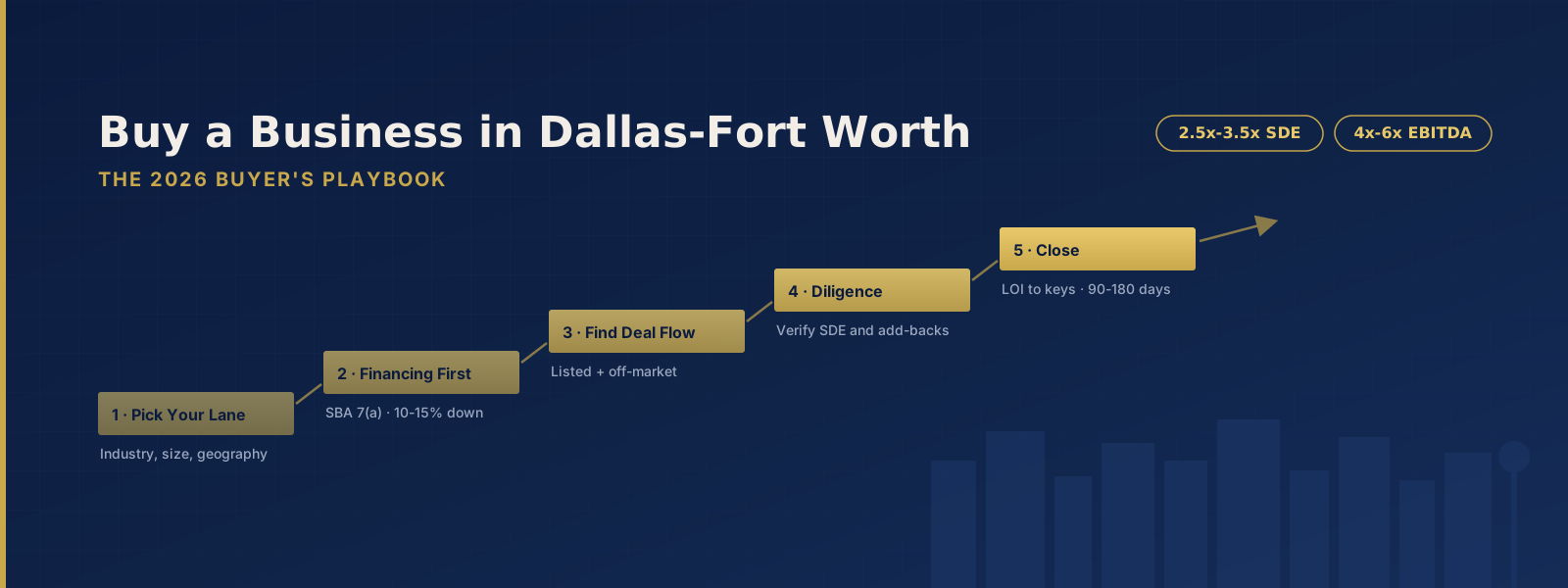
Step 1: Pick Your Lane Before You Shop
The buyers who close are the buyers who focus. Before you look at a single listing, write down three things: the industries you understand or can learn fast, the size of company you can afford, and the geography you will actually drive to.
Size is measured in earnings, not revenue. Smaller companies are priced on seller's discretionary earnings (SDE): profit plus the owner's salary and perks. Larger ones are priced on EBITDA, which assumes a manager is paid to run the company. Know which number a listing is quoting, because the multiple attached to each is different.
Owner-operator businesses under roughly $1M in SDE trade at 2.5x-3.5x SDE. Companies with $1M+ EBITDA and a management team command 4x-6x or more. Recurring revenue, customer diversity, and low owner dependency move a deal toward the top of its range. See our full breakdown of EBITDA multiples by industry.
Step 2: Line Up Financing Before You Fall in Love
In DFW, the workhorse is the SBA 7(a) acquisition loan: up to $5M, typically 10-15% down, roughly 10-year terms. On a $2M deal, that means somewhere around $200,000-$300,000 of your own capital, plus reserves for working capital and closing costs.
Then there is the seller. In this market it is common for the seller to carry 10-20% of the price as a note, which lowers your cash at closing and keeps the seller invested in your success through the transition. Our guide to seller financing explains how those notes are structured and why banks like seeing them.
Here is why this step comes second and not fourth: brokers triage buyers. When two offers land, the one with a lender letter and proof of funds gets the callback. Get prequalified with an SBA lender before you shop. It costs you nothing and it changes how sellers treat you.
Step 3: Learn Where the Good Deals Hide
About half the market is listed: brokers package a company into a confidential information memorandum and show it to qualified buyers under NDA. The listed market moves fast for good companies. A clean HVAC or plumbing business with strong service agreements can draw multiple offers in weeks.
The other half never gets listed. Off-market deals come from direct outreach, relationships, and buyer networks that hear about a retiring owner before the listing exists. This is where the best economics usually live, because you are not bidding against ten other buyers.
Do both. Watch the listed market to calibrate pricing. Work the off-market channels to find the deal nobody else sees. If you want DFW deal flow coming to you, join our buyer network and tell us your criteria.
Step 4: Read the Deal Like a Pro
When the financials arrive, three disciplines protect you.
Verify the earnings
Most small business P&Ls are adjusted with add-backs: the owner's salary, personal vehicle, one-time expenses. Legitimate add-backs are normal. Creative ones are how buyers overpay. Tie every add-back to a tax return line before you accept it.
Know what is inside the price and what is not
Furniture, fixtures, and equipment are inside the multiple. The trucks, the tools, the racking: they convey with the business, not on top of the price. Real estate is the opposite. It is always valued separately from the company. If the seller owns the building, insist on seeing the business priced with and without the property, then decide whether to buy it or lease it back. Our piece on sale-leasebacks shows how sellers think about that split.
Hunt the two silent killers
First, customer concentration: any single customer above 15-20% of revenue is a risk your lender will flag too. Second, owner dependency: if every customer relationship and every estimate runs through the seller personally, you are not buying a business. You are buying a job with a debt payment.
Step 5: Offer, Diligence, Close
When the numbers hold up, you move to a letter of intent: price, structure, what conveys, and an exclusivity window so the seller stops shopping your deal. The LOI is not the finish line. It is the starting gun for due diligence, which typically runs 30-60 days while your lender underwrites in parallel.
On larger deals, budget for a quality of earnings report. It is the cheapest insurance in M&A. And before closing day, understand the working capital adjustment, because that is where unprepared buyers and sellers leak real money at the wire.
Plan the whole journey at 90-180 days from serious search to keys in hand, with a 90-day transition from the seller after close. Structure that transition in writing. You want his cell phone answering for you in month two.
The Five Mistakes First-Time DFW Buyers Make
- Shopping without financing. Brokers stop returning calls from buyers who cannot show proof of funds.
- Buying revenue instead of earnings. A $4M revenue company with $250K of real SDE is a smaller business than it looks.
- Skipping the concentration check. One anchor customer at 40% of revenue can sink you in year one.
- Underestimating working capital. The loan buys the business. You still need cash to run it.
- Disrespecting the seller's story. In DFW especially, owners sell to people they trust with their people. Win the relationship and you will win deals better capitalized buyers lose.
The Kingdom Broker view: a business is more than cash flow. It is a platform for provision, generosity, and legacy. Buy like a steward, not a speculator: honest numbers, a fair price, and a plan to take care of the people who built the thing. That approach also happens to win negotiations.
Buying a business in Dallas-Fort Worth is the fastest path to ownership this market offers. The deals are here. The financing exists. The retiring generation is looking for you. Do the work in this order: lane, financing, deal flow, diligence, close, and you will be signing payroll in a company of your own before next summer.
Know What a Fair Price Looks Like
Our free valuation engine shows you what a DFW business is really worth. Sellers use it to set their number. Smart buyers use it to check one.
Get Your Free Valuation