Business Broker Fees in Texas Explained: Typical, Average, and Success Fees
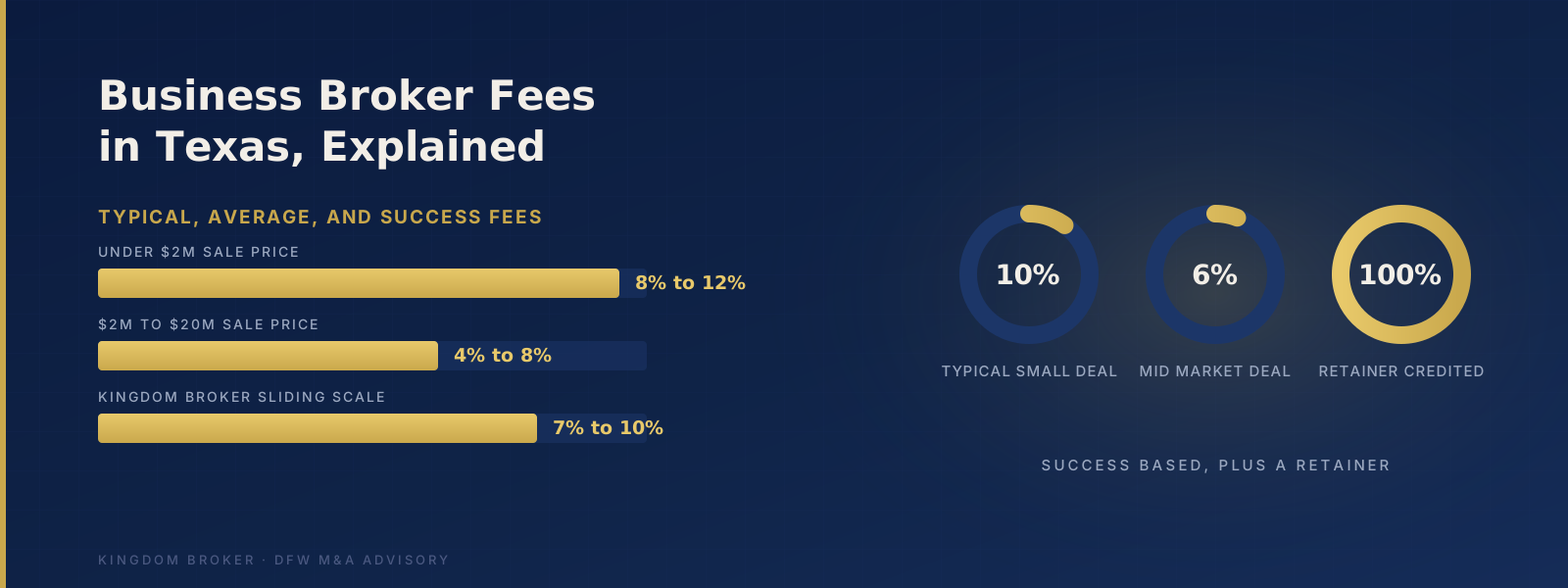
A typical business broker fee is 8% to 12% of the sale price on deals under $2 million, 6% to 8% from $2 million to $5 million, and 3% to 6% from $5 million to $20 million. Nearly all of it is a success fee paid only when the business actually closes, most firms carry a minimum of roughly $30,000 to $75,000, and many charge a retainer that is credited back against the success fee at closing.
That is the short answer. The long answer matters more, because two brokers quoting what sounds like the same fee can be $150,000 apart on the same deal depending on how the structure is written. Here is the whole landscape: the scales, what a success fee actually covers, why retainers exist, and the definitions in the agreement that quietly change the number.
Typical and Average Business Broker Fees by Deal Size
Business broker commissions in Texas vary based on the size of the deal. Here is the general landscape:
| Deal Size | Typical Commission | Commission Amount |
|---|---|---|
| Under $1M | 10-12% | $80K-$120K |
| $1M-$2M | 8-10% | $80K-$200K |
| $2M-$5M | 6-8% | $120K-$400K |
| $5M-$10M | 4-6% | $200K-$600K |
| $10M-$20M | 3-5% | $300K-$1M |
The percentage decreases as deal size increases because the dollar amount is still substantial. A 5% commission on a $10M deal is $500,000, which is more than enough to fund a comprehensive sale process.
Averages are less useful than most owners expect. The published average across lower middle market deals lands near 8% to 10% under $2 million and near 5% to 6% between $5 million and $10 million, but the average hides the four things that actually move your number.
What drives your fee up or down
- Deal size. The dominant driver. Percentage fees fall as value rises because the dollar fee still funds the process. Moving from a $1.5M sale to a $6M sale can cut the effective rate roughly in half.
- The minimum fee. Below roughly $600,000 of sale price, the minimum controls the outcome rather than the percentage. A $50,000 minimum on a $400,000 sale is 12.5%, no matter what the headline percentage says.
- Complexity. Multiple entities, real estate in the deal, licensing transfers, messy books, or a carve out all add months of work and push the quote toward the top of the range.
- Buyer depth in your industry. A business with ten plausible institutional acquirers is easier to run a competitive process on than one with three. Scarce buyer pools raise the fee because they raise the effort.
The Lehman Scale and the Double Lehman
Some brokers and M&A advisors use a tiered structure called the Lehman Scale. The original, invented in the 1970s, works like this:
- 5% on the first $1M of the sale price
- 4% on the next $1M
- 3% on the next $1M
- 2% on the next $1M
- 1% on everything above $4M
On a $5M deal, the original Lehman Scale commission would be $150,000, an effective rate of 3%.
Almost nobody in the lower middle market uses the original anymore. The Modified Lehman, usually called the Double Lehman, doubles every tier to 10, 8, 6, 4, 2. Some firms flatten the top tier at 2% or 3% instead of 1%. The vocabulary is identical, so read the actual percentages in the agreement rather than the label above them.
| $5,000,000 sale price | Original Lehman | Double Lehman |
|---|---|---|
| First $1M | $50,000 at 5% | $100,000 at 10% |
| Second $1M | $40,000 at 4% | $80,000 at 8% |
| Third $1M | $30,000 at 3% | $60,000 at 6% |
| Fourth $1M | $20,000 at 2% | $40,000 at 4% |
| Fifth $1M | $10,000 at 1% | $20,000 at 2% |
| Total | $150,000 (3.0%) | $300,000 (6.0%) |
Same deal, same scale name, $150,000 apart. This one table is the most valuable thing on this page. Ask any candidate to run their scale on your expected sale price and put the dollar answer in writing.
What Is a Success Fee, Exactly
The success fee is the commission paid only if and when the business closes. It is how nearly all sell-side advisory is compensated, and it is the part owners should read hardest, because the percentage is only half of the equation. The other half is the base it applies to.
Look for how the agreement defines transaction value or total consideration. The definition usually decides whether these are inside the fee base:
- Assumed debt. If the buyer assumes obligations, some agreements count that toward the price you pay a fee on.
- Seller notes and earnouts. Is the fee owed at closing on money you have not yet received? A fair structure pays the fee on contingent consideration as and when you collect it.
- Real estate. If you own the building, it is valued separately from the business, and it should be treated separately in the fee schedule too. A commission percentage built for a cash flow business applied to a real property transfer is expensive. Always look at your outcome both with and without the real estate.
- Working capital. Whether delivered working capital counts toward transaction value can move the fee by tens of thousands.
- Consulting or employment payments to you post closing. These are compensation, not purchase price, and generally should not be in the fee base.
One more clause: the tail. If you terminate the engagement, the broker typically still earns a fee for 12 to 24 months on buyers they introduced. That is fair and standard. A tail that reaches any buyer from any source is not.
What Kingdom Broker Charges
Kingdom Broker charges a retainer, lower than most brokerages, plus a success fee on a sliding scale of 7 to 10 percent by deal size. The larger the deal, the lower the percentage. The retainer covers the work that happens before any buyer exists: normalizing your financials, building the valuation, and writing your CIM. It is credited back against the success fee at closing.
For owners who qualify, we also offer the No-Cost Exit™, a custom built exit plan personalized to your business, your timeline, and your legacy. Book a call to see how it works for your business.
Our philosophy is simple: we eat what we kill. The large majority of our compensation comes from successfully closing your deal. That alignment of interest is the whole point of a success based structure, and it is worth confirming with any advisor you interview.
What You Get for the Fee
A good business broker does not just "find a buyer." Here is the full scope of what your commission covers:
Pre Market Preparation
- Comprehensive business valuation based on your financials and industry multiples
- Financial analysis including EBITDA normalization and add back identification
- Professional CIM creation (this alone would cost $10,000-$25,000 from an outside firm)
- Strategic pricing recommendation
- Deal structure advisory
Marketing and Buyer Sourcing
- Confidential marketing to qualified buyer database
- Targeted outreach to PE firms, family offices, and strategic acquirers
- NDA management and buyer screening
- Buyer qualification (financial capability, experience, intent)
- Facility tours and management presentations
Negotiation and Closing
- Offer analysis and comparison
- LOI negotiation
- Deal structure optimization (asset vs. stock, seller notes, earnouts)
- Due diligence management
- Coordination with attorneys, CPAs, and lenders
- Closing coordination
Confidentiality Protection
This is often overlooked but enormously valuable. Your broker manages the entire process behind the scenes. Your employees do not find out. Your customers do not hear rumors. Your competitors do not learn you are for sale. One leaked piece of information can destabilize your business and kill a deal.
Retainers, and Why They Exist
There are two models in the industry, and the retainer question causes more confusion than any other part of a fee conversation.
Success only: the broker collects nothing until closing and takes all of the risk. The tradeoff is real. A firm carrying that risk across many listings is often less selective about which businesses it takes on, and it has a structural incentive to push any deal to the finish line rather than the right deal at the right price. Success only advisors also tend to invest less in preparation, because preparation costs them cash today for a payday that may never arrive.
Retainer plus success fee: the broker charges an engagement fee, commonly $5,000 to $25,000 for businesses in the $2M to $10M range, that funds the work done before a buyer exists, then earns a success fee at closing. The retainer is not the compensation. It is the fuel for financial normalization, the valuation, the CIM, and the buyer research, all of which happen in the first sixty days.
Three tests for whether a retainer is fair:
- Is it credited against the success fee at closing? It should be. If it is not, you are paying twice for the same work.
- Are the deliverables named in the agreement? A retainer attached to a specific list of documents and dates is an investment. A retainer attached to nothing is a fee.
- Is it proportionate to the deal? A $25,000 retainer on a $1M business is out of scale. The same retainer on an $8M business is ordinary.
Be equally cautious in the other direction. A broker who asks for nothing at the start and quotes 15% at the end is not doing you a favor. Quality advisory costs money, and the cheapest option is rarely the best one. What you want is a structure where the majority of the money is still at risk on the outcome.
The Other Costs of Selling
The broker fee is the visible number. It is rarely the only one, and on many deals it is not the biggest variable in what you actually take home.
- Quality of earnings review: $8,000 to $25,000 depending on complexity, often required by the buyer's lender. See what a QoE costs in DFW.
- Transaction attorney: $10,000 to $40,000 for a properly negotiated purchase agreement. This is not the place to economize.
- Taxes: the single largest line item on most deals. Whether you structure an asset sale or a stock sale can move your net by six figures, and the full picture is in tax implications of selling a business.
- Escrow and holdbacks: commonly 5% to 15% of the price held for 12 to 24 months. Not a cost, but not cash at closing either.
The Real Cost of NOT Using a Broker
Every owner considers selling on their own to save the commission. Here is what actually happens in most cases:
The Math on Going Solo
Business value: $3,000,000
Broker commission (8%): $240,000
Owner thinks: "I will save $240,000 by selling myself."
What actually happens:
Owner sells for $2,400,000 (20% discount because no competition, weak negotiation, buyer detected desperation)
Owner spent 400+ hours on the sale process (time away from running the business)
Revenue dipped 10% during the process because the owner was distracted
Net loss vs. using a broker: $360,000+
Study after study shows that businesses sold with professional representation sell for 15-25% more than those sold by owners. On a $3M deal, even a 10% higher price ($300,000) more than covers the commission and then some.
The honest caveat, because it belongs here: that lift comes from competition, not from representation by itself. If a process only ever produces one interested buyer, the fee did not earn its keep. And for some owners the fee genuinely does not make sense, which is the case laid out in is it worth using a business broker.
How to Choose the Right Broker
Not all brokers are equal. Here is what to evaluate:
- Deal size experience: A broker who sells $200K businesses is not the right broker for your $5M company. Make sure they have closed deals in your size range.
- Industry knowledge: Does the broker understand your industry? Can they speak intelligently about your business to buyers?
- Buyer access: How many qualified buyers can they reach? Do they have relationships with PE firms, family offices, and strategic acquirers?
- Track record: How many deals have they closed in the last 12 months? What is their average time to close?
- References: Can they connect you with past clients who will speak honestly about the experience?
- Communication style: You will work closely with this person for 6 to 12 months. Make sure the fit is right.
The full interview script, including the ten questions to ask and the red flags worth walking away from, is in how to find a good business broker in Texas. For a side by side comparison of firms in this market, start with our guide to the best business brokers in Texas and the city pages for Dallas, Fort Worth, and Plano.
Frequently Asked Questions
What is a typical fee for a business broker?
A typical business broker fee is 8% to 12% of the sale price on deals under $2 million, 6% to 8% from $2 million to $5 million, and 3% to 6% from $5 million to $20 million, almost always paid as a success fee at closing. Most firms also carry a minimum fee of roughly $30,000 to $75,000, and many charge a retainer that is credited against the success fee. Deal size is the single largest driver of the percentage.
What is the average fee for a business broker?
Across lower middle market transactions the average total fee lands near 8% to 10% of sale price under $2 million and near 5% to 6% between $5 million and $10 million, because tiered scales pull the effective rate down as value rises. The average is less useful than the structure. A 10% flat fee and a double Lehman scale produce very different numbers on the same deal.
What is the success fee for a business broker?
The success fee is the commission paid only if and when the business actually closes, and it is the main way sell-side brokers are compensated. It runs roughly 3% to 12% of total transaction value depending on deal size, and any retainer paid earlier is normally credited against it. Read the definition of transaction value closely, since whether it includes assumed debt, seller notes, earnouts, and real estate changes what you owe. Kingdom Broker charges a retainer, lower than most brokerages, plus a success fee on a sliding scale of 7 to 10 percent by deal size.
Should I pay a retainer to a business broker?
A retainer is normal in lower middle market M&A and is often a good sign, because it funds the financial normalization, valuation, and CIM work that happens before any buyer appears. Typical retainers run $5,000 to $25,000. The requirements are that it is credited against the success fee at closing and that the deliverables are named in the agreement. A large non refundable retainer with no defined work product attached is a problem.
Are business broker fees negotiable in Texas?
Yes, though usually less on the percentage than on the structure. The terms that move most often are the minimum fee, how the tail period is scoped, whether real estate is carved out of the fee base, whether contingent consideration is paid as collected rather than at closing, and the length of the exclusivity period. Those clauses are frequently worth more than a half point on the headline rate.
Who pays the business broker, the buyer or the seller?
In a standard sell-side engagement the seller pays, and the fee comes out of proceeds at closing. Be alert to any arrangement where an advisor is compensated by both sides. One side per deal is the clean standard, and any dual role should be disclosed in writing before you engage.
Your Next Step
Get a number before you evaluate any fee. A percentage means nothing until you know what it applies to, and the valuation changes which structure is right for you. Our free valuation takes about ten minutes and costs nothing. Everything else we publish for owners preparing to sell lives in the Seller Library.
Know Your Number Before You Talk Fees
Free, confidential valuation in about ten minutes. Use it to evaluate any broker in Texas, any fee structure, and any offer.
Get Your Free Valuation Questions first? Email Eric@KingdomBroker.com