Best Business Broker for Manufacturing Companies in Texas: How to Choose
You did not build a machine shop by accident. Twenty years of tolerances held, deliveries hit, and payroll made. Now you are thinking about the exit, and the first decision is not price. It is who runs your sale.
Here is the uncomfortable truth. Most brokers list businesses. Manufacturing companies need to be sold. The gap between those two words is often seven figures.
This guide covers what makes a manufacturing sale different, what Texas shops are actually trading for in 2026, and how to choose a business broker for manufacturing companies in Texas without learning the expensive way.
Why a Manufacturing Sale Is Different
A service business sells cash flow and a customer list. A manufacturing business sells cash flow plus a floor full of capital equipment, work in process, certifications, skilled labor, and often the building itself. Every one of those changes the math. Every one is a place where a generalist broker can cost you real money.
Your Equipment Sells Inside the Multiple
The most common misunderstanding we hear from Texas owners sounds like this: "The business does $800K in EBITDA, so 4x gets me $3.2M, plus my $1.5M in machinery on top."
That is not how buyers price it. FF&E, your furniture, fixtures, and equipment, is included inside the EBITDA multiple. The machines are what produce the earnings, so they do not get counted a second time. A broker who prices your deal with equipment stacked on top of the multiple will attract zero serious offers and burn months of your confidentiality finding that out. Here is the full explanation of how FF&E is treated in a sale.
Real Estate Is a Separate Check
The building is the exception. If you own your facility, it is valued separately from the business, and a competent advisor shows you the number both ways: value with the real estate and value without it. Some buyers want the property. Many prefer a market rate lease. A sale leaseback can put a second check in your pocket and make the business itself easier to finance. Insist on seeing both versions before you go to market. If a broker cannot produce them, keep interviewing.
Customer Concentration Gets Priced Hard
Plenty of strong Texas shops grew up around two or three OEM relationships. Buyers respect the loyalty and discount the risk. Once a single customer passes 15-20% of revenue, expect harder questions, more deal structure, or a lower multiple. Concentration is one of the top deal killers we see. A manufacturing literate broker knows how to position long tenures, active POs, qualified part status, and switching costs to soften it. A generalist just forwards your P&L and hopes.
What Texas Manufacturing Businesses Sell For in 2026
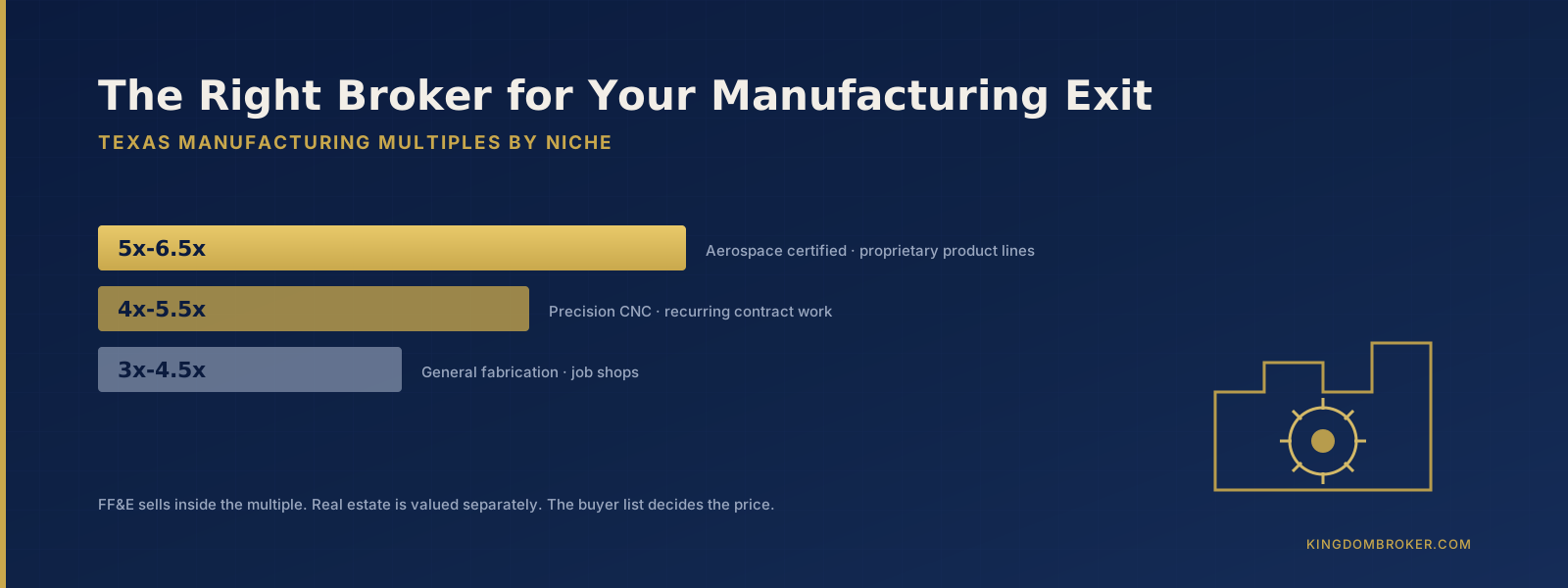
Ranges, not points. Where you land inside the range depends on the driver next to it.
- General fabrication and job shops: 3x-4.5x EBITDA. Driver: repeat customers and booked backlog versus one-off project work.
- Precision CNC and machining: 4x-5.5x EBITDA. Driver: recurring programs, long term agreements, and documented quality systems.
- Aerospace and defense certified shops, or proprietary product lines: 5x-6.5x and up. Driver: AS9100 or ITAR status, IP, and backlog visibility that buyers can verify.
Two notes on those numbers. First, they describe enterprise value on normalized EBITDA, with FF&E inside the multiple and real estate handled separately, as covered above. Second, deals above roughly $1M in EBITDA attract private equity and strategic buyers, and those buyers verify everything. A quality of earnings report ordered before you go to market usually pays for itself in held price and saved time. For the wider picture across sectors, see our guide to EBITDA multiples by industry.
What a Manufacturing Broker Actually Does Differently
The right question is not "who will list my business." It is "who can put four qualified buyers at my table without my competitors or customers finding out."
Here is what that looks like in practice:
- A blind profile and NDA gate. Your company is marketed anonymously. Buyers sign before they learn your name. Your employees, customers, and competitors hear nothing until you choose.
- A real buyer database. PE platforms rolling up precision machining, strategic acquirers filling capability gaps, independent sponsors, and family offices. Here is what private equity firms look for when they evaluate a shop like yours.
- A competitive process. One buyer is not a market. Multiple qualified offers are what move price and terms in your favor.
- Diligence preparation before diligence starts. Financials normalized, add-backs documented, the checklist answered before buyers ask.
At Kingdom Broker we run this as an AI-native process. Our systems screen thousands of buyers by industry, check size, and mandate. Then Eric works the shortlist personally. Software finds the crowd. A deal maker picks the dance partners.
Seven Questions to Ask Before You Hire Anyone
- How many manufacturing companies have you closed, and at what size? Closings, not listings. The difference matters.
- Who were the last ten buyers you brought to a deal like mine? Names can be blinded. The mix of PE, strategic, and individual tells you everything about their reach.
- How will you protect confidentiality from my customers, competitors, and employees? Ask to see a sample blind profile.
- How do you treat FF&E and real estate in your valuation? The right answer: FF&E inside the multiple, real estate valued separately and shown both ways. Any other answer, keep walking.
- What are your fees, in writing? Here is what brokers charge in Texas so you can compare like for like.
- Will you run a competitive process or shop me to one buyer? Some shops quietly work for a favorite buyer. You want an advocate, not a matchmaker with a favorite.
- Who does the work after I sign? If the answer is a junior associate you have never met, the pitch was the product.
Red Flags That Cost Sellers Millions
- A valuation pitched high to win your signature, followed by price cuts once you are locked in.
- Equipment added on top of the multiple to flatter the number. It signals the buyer conversations will go badly.
- No manufacturing closings. Restaurants and retail are a different sport.
- A one buyer process presented as a relationship advantage.
- Fees that all land before the work starts, with nothing riding on your closing.
The No-Cost Exit™. Fair fees are success weighted. Kingdom Broker retainers already run lower than most Texas firms charge, and qualified sellers can use our No-Cost Exit™ option to take the retainer off the table entirely. Book a call and we will show you how it works.
Why DFW Manufacturing Is a Seller's Market Right Now
Fort Worth anchors one of the densest aerospace and defense corridors in the country. Reshoring keeps pulling contract work back onto Texas floors. Industrial growth from Alliance down to South Dallas keeps fabrication, machining, and finishing shops busy. And private equity groups have spent the last three years assembling precision machining platforms that need add-on acquisitions to grow.
Translation: qualified buyers are actively hunting DFW shops in the $1M-$20M range, and prepared sellers are the scarce side of the market. If you want the full step by step process, read How to Sell a Manufacturing Business in Texas.
A Quick Example
A Tarrant County precision machining shop: $4.2M revenue, $950K normalized EBITDA, AS9100 certified, owner off the floor, largest customer at 22% of revenue. At 4.75x, the business is worth roughly $4.5M, equipment included. The building appraises separately at $1.8M and can be sold with the deal or kept and leased back for income. (Numbers are illustrative, not a promise.)
Handled by a generalist who stacks the equipment on top and emails the package to a list, that deal stalls and the market hears about it. Handled properly, it closes with competing offers and the real estate answered on the seller's terms.
Choosing a business broker for your manufacturing company in Texas is the highest leverage decision of your exit. Get it right and everything downstream gets easier. Start with the number: get a free valuation estimate from Kingdom Broker and see where you stand before anyone else knows you are thinking about it.
Find Out What Your Manufacturing Business Is Worth
We value Texas manufacturing companies every week, with FF&E inside the multiple and the real estate shown both ways. No pressure, just a real number grounded in what buyers are paying right now.
Get Your Free Valuation