What Multiple Do Plumbing Businesses Sell For?
Every plumbing owner wants to know the same thing before they start the sale process.
What's my number?
It's a fair question. And unlike a lot of industries where multiples are murky or all over the place, plumbing actually has a pretty clear range — if you know where to look and what drives the spread.
Here's what's actually happening in the DFW lower-middle market right now.
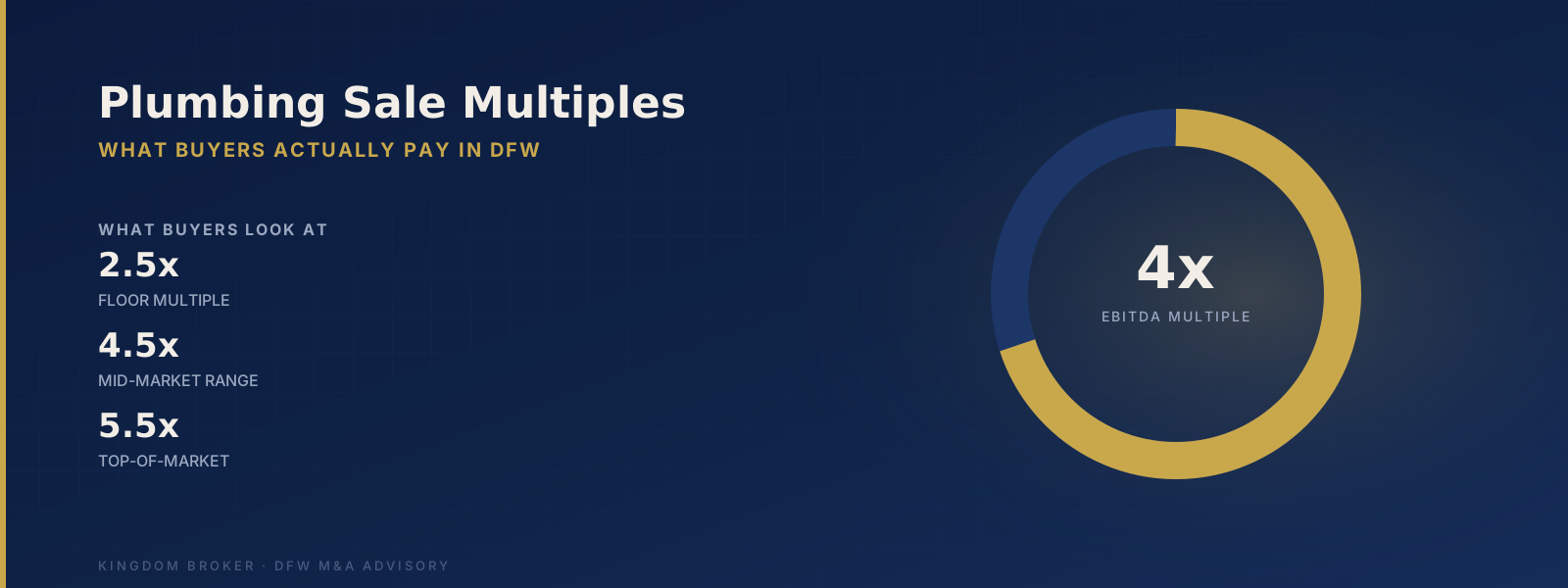
The Honest Range: 2.5x to 5x EBITDA
Most plumbing businesses in the $1M–$20M revenue range sell for somewhere between 2.5x and 5x EBITDA. That's your realistic corridor in today's market.
Where you land inside that range depends on four things we'll break down below. But first, let's ground the numbers.
If your business generates $600,000 in EBITDA (that's earnings before interest, taxes, depreciation, and amortization — essentially your real owner cash flow), you're looking at a deal value somewhere between $1.5M and $3M depending on what a buyer sees when they look under the hood.
A business at $1.2M in EBITDA could clear $4.5M–$5.5M if the story is clean. That same business with sloppy books, owner-dependent operations, or a single large customer could land closer to $3M — or struggle to attract qualified offers at all.
That gap isn't arbitrary. It reflects real risk from the buyer's perspective.
Why Revenue Size Matters — But Not the Way You Think
Buyers don't pay a premium just because you're bigger. They pay a premium because bigger businesses are usually less risky to operate without the original owner.
Here's how DFW plumbing deals roughly break down by size:
- Under $500K EBITDA: 2.5x–3.5x. Strong individual buyers and small PE-backed searchers. Owner dependency is usually a concern here.
- $500K–$1.2M EBITDA: 3x–4.5x. The sweet spot for SBA-backed deals and strategic acquirers. Multiple expands quickly if operations are clean.
- $1.2M–$3M+ EBITDA: 4x–5.5x. PE firms and regional platform builders pay a meaningful premium. Recurring service agreements matter a lot here.
The jump from sub-$500K to the $500K–$1M range is often the biggest multiple expansion moment. It's worth understanding why — and engineering your business to clear that threshold before you go to market.
The 4 Factors That Drive Multiple Expansion
1. Recurring Revenue
Maintenance agreements, service contracts, and annual membership plans are gold to buyers. They reduce revenue volatility and make your business feel more like an asset than a bet.
A plumbing company doing 30%+ of revenue from recurring contracts will almost always command a higher multiple than a company of the same size living purely on reactive service calls — even if the EBITDA numbers look identical on paper.
If you don't have a maintenance program yet, and you're planning to sell in the next 2–3 years, building one is one of the highest-ROI moves you can make.
2. Owner Independence
This one is blunt: if the business needs you to run, buyers will pay less. Often a lot less.
We write about this in depth over at why owner dependency kills business value, but the short version is this — every qualified buyer is asking themselves, what happens to revenue when this guy leaves? If the answer is "probably a lot," your multiple shrinks.
Field supervisors, a solid dispatcher structure, documented SOPs, and a service manager who can handle day-to-day operations all push your multiple up. They're proof the machine runs without you.
3. Customer Concentration
If one builder, property manager, or commercial client represents more than 20–25% of your revenue, buyers get nervous. And nervous buyers lower their offers — or walk away entirely.
We cover this in the customer concentration risk post if you want the full breakdown. The fix isn't complicated but it takes time, which is another reason to start your exit prep early.
4. Clean Financials
Buyers in the $2M–$8M deal range often require a Quality of Earnings report before closing. This isn't optional — it's standard. And what it reveals either confirms your multiple or erodes it.
Co-mingled personal expenses, inconsistent revenue recognition, undocumented add-backs — these all create friction and discount your number. Clean books, properly documented add-backs, and two to three years of tax returns that tell a consistent story can be worth hundreds of thousands of dollars to your final check.
See how the QoE process works in the DFW market over at our quality of earnings guide.
What the DFW Market Looks Like Right Now
North Texas is one of the most active markets in the country for home services M&A. Population growth in Collin, Denton, Tarrant, and surrounding counties means demand for plumbing services isn't slowing down — and buyers know it.
PE-backed consolidators are actively building plumbing platforms in DFW. That competition among buyers is good for sellers. When multiple qualified buyers are bidding on the same business, multiples tend to push toward the top of the range — or above it.
But "DFW" doesn't mean every deal gets a premium. The premium goes to the businesses that look the part: documented systems, recurring revenue, clean books, and leadership that can survive an ownership transition.
If you're thinking about selling in the next 12–36 months, the time to build those things is now — not after you've signed a LOI.
How to Know Where You Actually Stand
The honest answer is: you need someone to look at your real numbers.
Multiples in the abstract don't mean much. A 4x multiple on $400K EBITDA is a $1.6M exit. A 3.5x multiple on $900K EBITDA — after proper add-back documentation — is a $3.15M exit. The math changes fast depending on where you actually are.
That's why a real valuation conversation matters before you make any decisions. Not a rough estimate based on revenue. A real look at your EBITDA, your recurring revenue mix, your customer base, and your operational structure.
If you want to see what that looks like in practice, the full guide to selling a DFW plumbing business walks through the whole process — from positioning to close.
And if you want to understand what buyers are actually evaluating when they underwrite a deal, the what PE firms look for post is worth your time even if you're targeting an individual buyer or a strategic acquirer.
The same criteria apply. The buyers just look different.
Find Out What Your Plumbing Business Is Worth
Get a real valuation — not a ballpark — based on your actual EBITDA, revenue mix, and market position in DFW.
Get Your Free Valuation