Free Valuation Calculator: Plumbing Business in DFW
You've spent years building a plumbing business in DFW. You've hired techs, bought trucks, chased receivables, and shown up on days you didn't feel like it. Now you're wondering what that's actually worth to a buyer.
Good question. Most owners are either way too optimistic or they're leaving serious money on the table by undervaluing what they've built.
Our free valuation tool gives you a defensible range in under five minutes. But before you punch in numbers, you need to understand how buyers actually price plumbing companies in the Dallas Fort Worth market, because the formula matters as much as the math.
How Plumbing Businesses Are Valued in DFW
Every plumbing business in this market gets valued the same way buyers think: what's the clean, recurring cash flow, and how much risk sits underneath it?
The starting point is Seller's Discretionary Earnings (SDE) or EBITDA, depending on deal size. Here's the rough split:
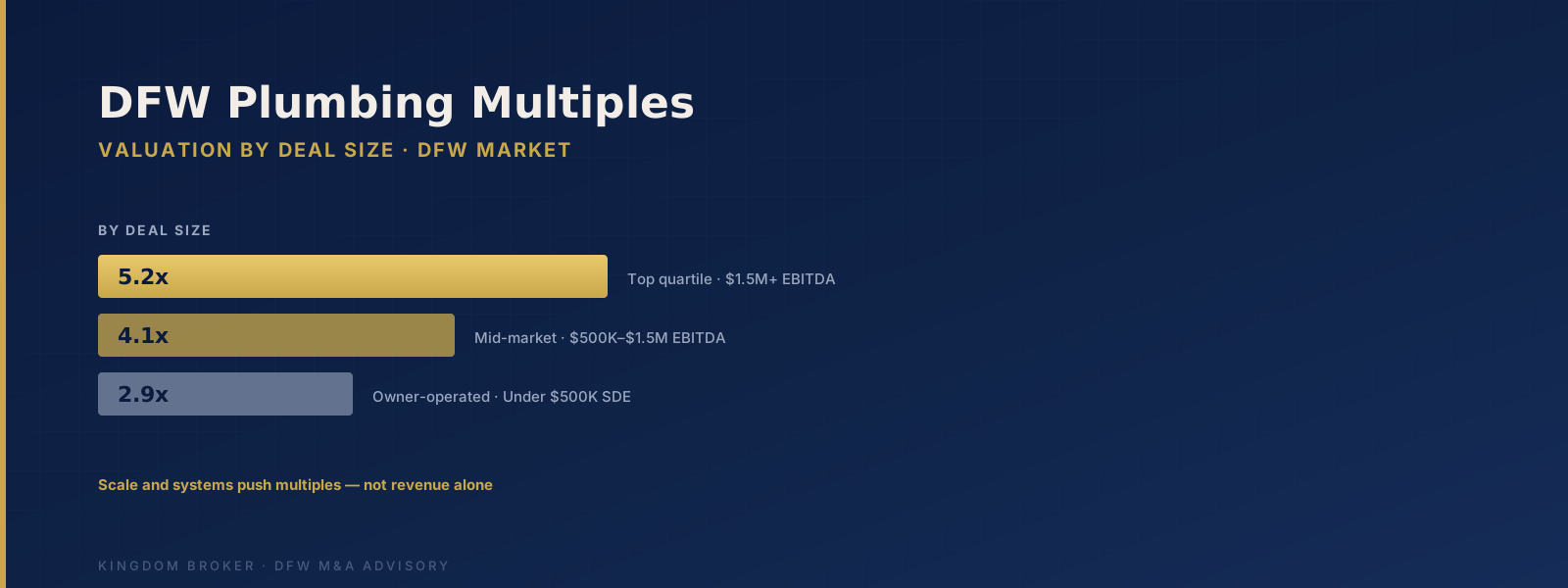
- Under $500K in annual profit, buyers use SDE, and multiples typically run 2.0x-3.5x
- $500K-$1.5M in annual profit: EBITDA-based pricing, multiples of 3.5x-5.0x
- $1.5M+ in annual profit, institutional buyers enter, and multiples can reach 5.0x-6.5x
Those ranges aren't guesses. They're what's actually closing in the lower-middle market across the Metroplex right now. A $400K SDE plumbing business in Burleson or Rockwall isn't going to fetch the same multiple as a $2M EBITDA operation with service agreements across Collin County. That's not a judgment, it's just math.
Why DFW Plumbing Companies Command a Premium
There's a reason private equity groups and strategic acquirers are circling the trades in Texas. The DFW population added over 170,000 people last year. That's houses, slab foundations, aging pipes, and new construction all feeding demand simultaneously.
Plumbing is recession-resistant in a way most businesses aren't. When the AC goes out, homeowners might wait a day. When the main line backs up, they're calling at midnight. That essential-service nature is priced into multiples, buyers pay more for businesses where demand is structurally durable.
DFW specifically adds a geographic premium. Buyers know the market grows, so a plumbing company with strong Google reviews and recurring maintenance agreements in Frisco or McKinney is telling a growth story without the owner having to say a word.
What the Calculator Actually Does
Our plumbing business valuation calculator isn't a magic box. It's a structured way to apply real-market logic to your specific numbers.
Here's what it factors in:
- Three years of revenue and owner earnings (smoothed to reduce noise from outlier years)
- Add-backs, personal expenses, one-time costs, owner salary above market replacement, see our add-backs guide if you're not sure what qualifies
- Multiple range based on your revenue tier and deal size
- Risk adjustments for owner dependency, customer concentration, and recurring revenue mix
The output is a low, mid, and high range, not a single number. Any broker giving you a single number without context is either guessing or telling you what you want to hear. Real buyers make offers within a range. You should know yours before anyone else does.
The Add-Back Math Most Owners Miss
This is where DFW plumbing owners consistently leave money on the table. If you've been running personal expenses through the business, a truck you use on weekends, health insurance for your family, a phone plan, those dollars get added back to your profit number before the multiple is applied.
Say you have $350K in stated net income but $80K in legitimate add-backs. Your SDE is $430K, not $350K. At a 3.0x multiple, that's a $240,000 swing in your sale price. That's real. That's worth getting right.
If you want to go deeper on this before running the calculator, read our piece on how add-backs work when selling a business.
The Three Factors That Move Your Multiple Up or Down
Two plumbing businesses with identical SDE can sell at very different multiples. The spread is driven by risk, and buyers price risk ruthlessly.
1. Owner Dependency
If you're the one running every estimate, managing every tech, and handling every difficult customer, a buyer sees a job they're buying, not a business. That pushes your multiple toward the low end of the range. A company with a field supervisor, a dispatcher, and systems that run without you sitting in the truck? That commands a premium.
We wrote an entire article on this, owner dependency is one of the biggest value killers in trades businesses. Worth a read before you list.
2. Customer Concentration
If one commercial account or homebuilder represents more than 20% of your revenue, expect a buyer to flag it. They'll either discount the multiple, require an escrow holdback, or walk. Diversified residential service revenue across hundreds of households is the profile buyers in DFW are actively chasing right now. Customer concentration risk is priced in, always.
3. Recurring Revenue Mix
Service agreements, maintenance plans, and preferred-customer memberships are worth more than one-call dispatch work. Not because the revenue is higher, but because it's predictable. Buyers underwrite deals based on what they can project forward. If you have 400 active maintenance agreements in Southlake and Allen, you're telling a story that commands top-of-range multiples.
What to Have Ready Before You Run the Numbers
The calculator works best when you have three things in front of you:
- Three years of P&L statements or tax returns (2022, 2023, 2024, or whatever your most recent three are)
- A rough list of personal expenses run through the business
- An honest answer on whether you could be replaced by a hired manager within 90 days
You don't need a CPA to run the tool. You need honest inputs. Garbage in, garbage out, and if you inflate your numbers in the calculator, you'll inflate your expectations going into conversations with buyers. That's how deals fall apart.
If you want to see how a buyer would stress-test your numbers formally, our piece on Quality of Earnings reports in DFW explains what due diligence actually looks like at this stage.
What Buyers Are Paying Right Now in DFW Plumbing
To give you real market context, here's what's happening in closed deals across the Metroplex in the last 18 months:
A residential service plumbing company in Denton County: $1.1M SDE, good Google presence, two lead plumbers who stayed post-close, sold at 4.4x. A smaller operation in Tarrant County at $280K SDE with heavy owner involvement went at 2.8x. A commercial-leaning plumbing contractor with $2.3M EBITDA and a solid government contract portfolio in Dallas County closed at 5.1x to a regional PE-backed platform.
The pattern holds. Size matters. Systems matter. Recurring revenue matters. And the DFW market is active enough that well-prepared sellers are finding qualified buyers within 90-120 days of going to market.
Run Your Valuation Now
You've built something real. The least you deserve is an honest look at what it's worth before you start talking to buyers, partners, or even your own family about what comes next.
The calculator takes less time than a service call and costs you nothing. Use real numbers. Get a real range. Then decide what you want to do with it.
Get Your Free Plumbing Business Valuation
Enter three years of numbers and get a defensible price range in under five minutes, no broker pressure, no obligation.
Get Your Free Valuation