Private Equity Buying DFW HVAC Companies: What to Know
You've probably heard the rumors at the supply house. Maybe a competitor sold. Maybe a PE-backed platform showed up in your inbox with a vague "acquisition inquiry." Maybe your accountant mentioned that multiples are high right now and you should think about timing.
It's not rumors. Private equity is absolutely buying HVAC companies in DFW, and they've been doing it hard for the last four years. The question isn't whether they're interested. The question is what that interest actually means for you, your team, and the legacy you've spent a decade building.
Let's pull back the curtain.
Why DFW HVAC Is a PE Magnet
Private equity loves recurring revenue. They love fragmented industries where one smart operator can buy twenty small companies, bolt them together, and sell the whole thing at a higher multiple than any individual piece was worth. That strategy has a name: the roll-up.
North Texas is a perfect roll-up hunting ground. The population growth is relentless: DFW adds more people every year than most mid-sized American cities have total. That means new rooftops, new service agreements, and new maintenance contracts. The heat alone creates demand that doesn't go away in a recession. And because most HVAC companies here are still owner-operated, the market is fragmented enough to give a PE firm years of acquisition runway before they run out of targets.
Add in the fact that Texas is a business-friendly state with no personal income tax and a legal environment that doesn't scare off outside capital, and you've got a magnet for institutional money that isn't going anywhere.
How PE Firms Actually Value an HVAC Company
This part matters. A lot of owners hear "private equity" and picture sky-high multiples paid by people with unlimited checkbooks. The reality is more nuanced, and knowing the nuance protects you.
PE buyers value HVAC companies on a multiple of Seller's Discretionary Earnings (SDE) for smaller deals, and EBITDA once you're past roughly $1.5M in owner earnings. The multiple they pay depends on a handful of factors.
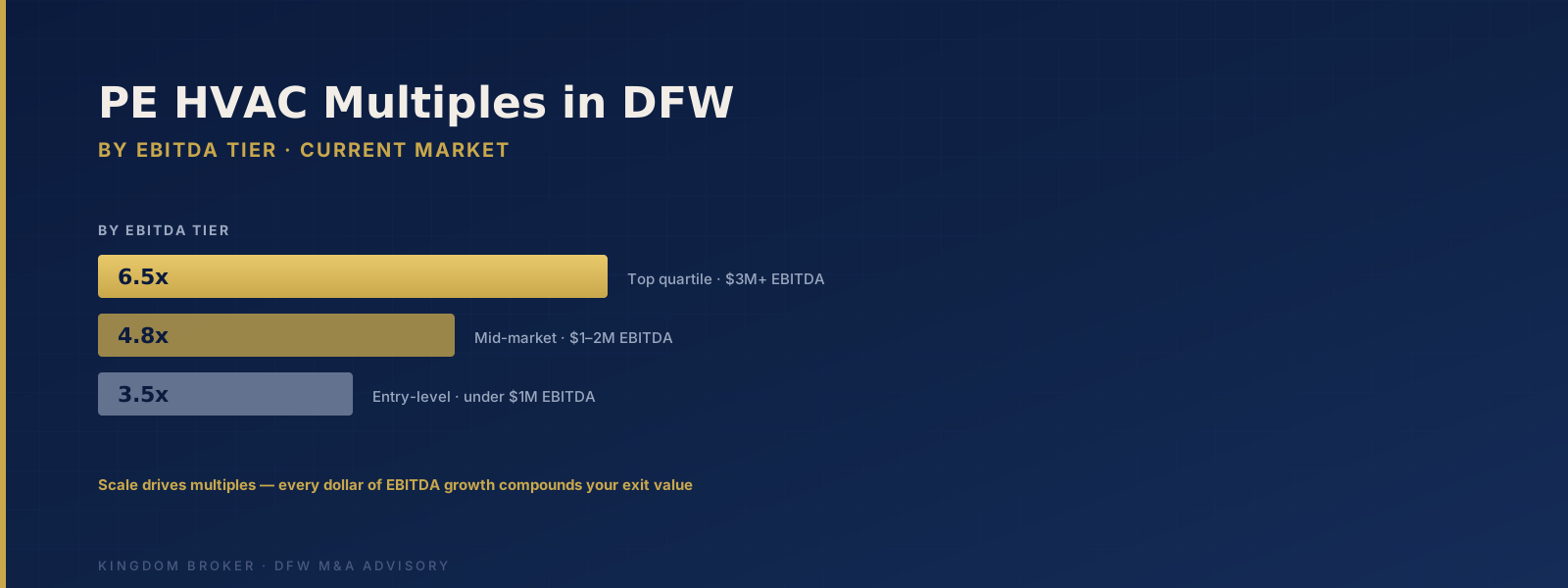
First: size. A company doing $500K in EBITDA might trade at 3.5-4.5x. The same business at $3M EBITDA could command 6-8x from the right platform buyer. That jump isn't random, larger businesses have management depth, more predictable cash flow, and lower key-person risk. You can read more about how this plays out in our HVAC business valuation breakdown.
Second: recurring revenue mix. A company where 40-60% of revenue comes from service agreements is worth materially more than a pure install-and-replace shop. PE buyers are buying the annuity stream. If you don't have a strong maintenance program, expect that to come up in every conversation, and expect it to compress your multiple.
Third: owner dependency. If the business can't run without you answering calls, managing techs, and quoting jobs, buyers will discount for that. Hard. We've written about this before, owner dependency quietly kills business value and it's the single most common reason deals fall apart or reprice at closing.
Fourth: customer concentration. If one general contractor, builder, or commercial client represents more than 20% of your revenue, PE underwriters will flag it. Diversified residential service beats concentrated commercial work in almost every roll-up model. See our piece on customer concentration risk if this sounds familiar.
What a PE Deal Structure Actually Looks Like
Here's where it gets real, and where a lot of owners get surprised.
PE firms rarely write a check for 100% of your company at close. The most common structure is a partial buyout with rollover equity. You might sell 70-80% of your business at close and roll the remaining 20-30% into the acquiring platform. That rollover stake is worth something on paper, the upside is that when the platform eventually sells (typically in 3-5 years), your rolled equity could pay out at a higher multiple than you sold for the first time.
That's the pitch. The fine print is that your rollover equity is illiquid, the timeline is PE's call, and the eventual exit depends on market conditions you can't control. Some owners come out of that second bite very well. Others feel like they left their chips at a table where they no longer hold cards.
You'll also see earnouts, a portion of your purchase price tied to hitting revenue or EBITDA targets for 12-24 months post-close. Earnouts sound reasonable when they're presented. They're harder when you're operating inside a larger platform and variables outside your control start affecting your numbers.
None of this means PE deals are bad. It means you need eyes wide open, and ideally an advisor in your corner who's seen these term sheets before. Understanding what PE firms actually look for before you sit across the table is non-negotiable.
What Selling to a Platform Actually Feels Like
The LOI gets signed. Champagne gets popped. Then due diligence starts.
PE-backed buyers do institutional-grade diligence. Expect 60-90 days of deep document review. They'll want three years of financials, your service agreement database, technician certifications, fleet records, insurance history, and more. If you haven't already, review our due diligence checklist so nothing blindsides you.
Most platforms will also commission a Quality of Earnings (QoE) report, a third-party accounting review that validates your EBITDA and scrutinizes your add-backs. This is normal. It's also where deals that were priced on seller-reported numbers sometimes get repriced. Clean books and conservative add-backs hold up. Aggressive ones don't.
Post-close, the integration experience varies wildly. Some platforms are hands-off, they bring capital and back-office systems and let you run operations. Others consolidate dispatch, HR, and purchasing fast. Before you sign anything, ask hard questions about what integration looks like in the first 90 days. Talk to owners who sold to that specific platform if you can find them.
Should You Sell to PE or Look for a Different Buyer?
Honest answer: it depends on what you want.
If maximizing total enterprise value is the goal, and you're comfortable with rollover equity and a potential earnout, a PE-backed platform may be your best path, especially if your EBITDA is above $1.5M and your recurring revenue percentage is strong.
If you want a clean break, full payout at close, and a buyer who will treat your team like family, a strategic buyer or a well-qualified individual operator might be a better fit, even if the headline multiple is slightly lower.
The deals that go sideways aren't usually the ones with bad buyers. They're the ones where the seller didn't know what they were optimizing for until it was too late to change the terms.
Start with your number. Start with what matters to you beyond the number. Then structure the process around those answers, not the other way around.
If you're not sure what your HVAC company is worth in today's DFW market, the first step is getting a real valuation, one that accounts for your revenue mix, team structure, and how PE buyers will actually underwrite your business. Get your free valuation here and we'll show you exactly where you stand.
Find Out What a PE Buyer Would Pay for Your HVAC Company
Get a free, no-pressure valuation built on real DFW deal data, so you know your number before any buyer does.
Get Your Free Valuation