How Plumbing Service Agreements Drive Higher Multiples
Every plumbing owner in DFW knows the feast-or-famine feeling. Hot summer, phones ring off the hook. January slowdown hits and the trucks sit. It's the nature of the trade, unless you've built a service agreement portfolio.
That portfolio is the single biggest lever most plumbing owners ignore. And it's the first thing serious buyers ask about when they sit across the table from us.
Here's why it matters so much, and what to do about it before you decide to sell.
What Buyers Actually Pay a Premium For
When a private equity group or a strategic acquirer looks at a DFW plumbing company, they're not just buying last year's revenue. They're buying a prediction of next year's revenue. The more certain that prediction, the more they'll pay.
That's the whole game.
A company doing $3M in revenue with 60% of it tied to recurring service agreements is a fundamentally different business than one doing $3M on pure break-fix calls. Same top line. Very different risk profile. And buyers price that difference aggressively.
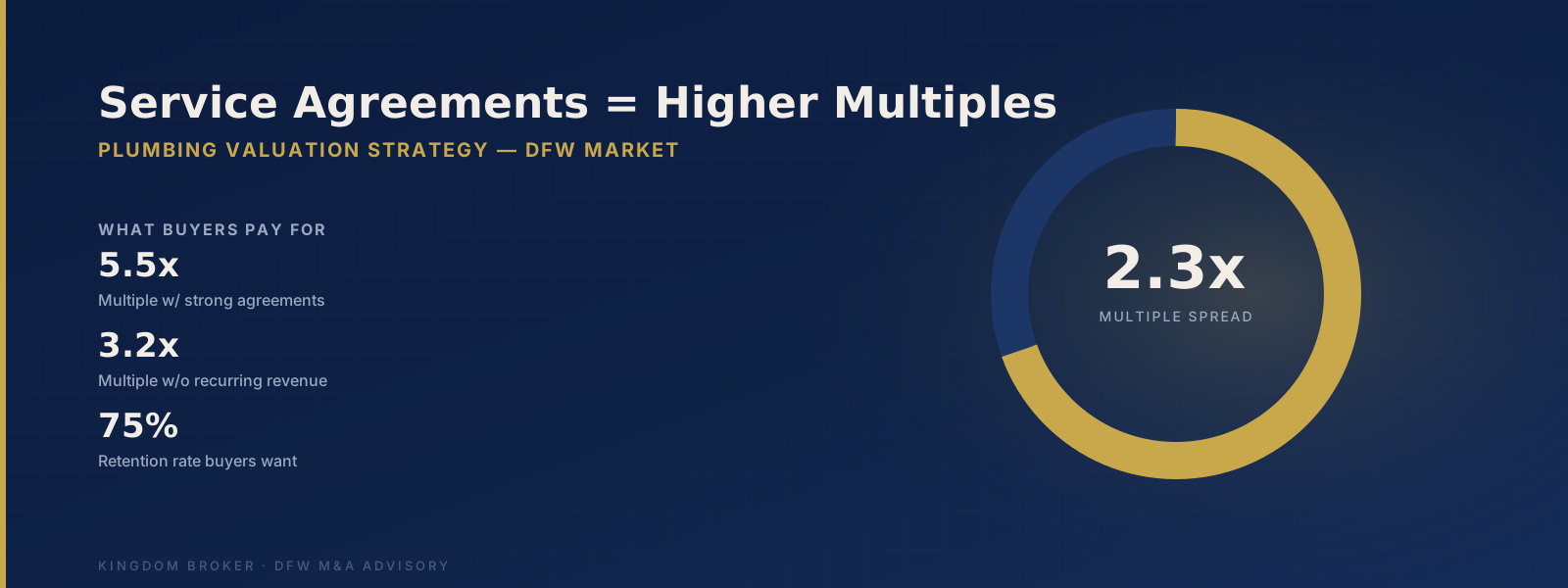
We've seen plumbing companies with strong agreement portfolios trade at 4.5x to 5.5x EBITDA in the DFW market. Companies with little or no recurring revenue? They're landing closer to 2.8x to 3.5x, if they land at all. That gap is real money. On $500K of EBITDA, we're talking about a $750,000 to $1M swing in your check at closing.
If you want to understand how buyers build that math, our piece on selling a plumbing business in DFW walks through the full picture.
The Dollar Value of a Single Service Agreement
Let's get concrete. A typical residential plumbing service agreement in the DFW market runs $150 to $350 per year per household, sometimes higher for commercial accounts. The agreement usually covers annual inspections, priority scheduling, and a discount on parts and labor.
That sounds modest. But now multiply it.
Five hundred agreements at $200 per year is $100,000 in predictable, prepaid revenue. It's also 500 households who called you first, not your competitor, when the water heater failed at 10pm on a Tuesday. That's where agreements compound: they generate recurring contract revenue AND they feed your break-fix ticket volume at higher close rates.
Buyers understand this deeply. They're not just valuing the $100K in agreement fees. They're valuing the downstream revenue those customers represent over a 5-to-7 year hold period.
Retention Rate Changes Everything
Not all agreement portfolios are equal. What separates a premium portfolio from a mediocre one is retention rate.
Buyers want to see 75% or better annual retention. If you're losing 40% of your agreements every year, the portfolio isn't sticky, it's just prepaid revenue you have to re-earn constantly. That's not what commands a premium multiple.
High retention tells a buyer three things: your customers trust you, your team delivers consistently, and your pricing is sticky enough that people don't cancel when their credit card gets charged. That's a healthy business. And what PE firms look for in a home services acquisition is exactly this kind of proof that customers don't leave.
How Service Agreements Reduce the Risk Flags That Kill Deals
Two of the most common deal-killers we see in plumbing transactions are owner dependency and customer concentration. Service agreements attack both.
When your revenue is tied to a recurring portfolio, rather than to one big commercial client or to your personal relationships, buyers can underwrite the business without you in it. That matters enormously. Owner dependency destroys value faster than almost anything else, and a strong agreement base proves your business runs on a system, not a personality.
Customer concentration is the other killer. If 40% of your revenue comes from two or three big accounts, every buyer's attorney is going to flag it. But 600 residential service agreements spread across Frisco, McKinney, Allen, and Prosper? That's diversification. No single customer accounts for more than a fraction of a percent. That's a clean book of business.
Our post on customer concentration risk goes deeper on why this matters at the due diligence stage.
Building a Service Agreement Portfolio Before You Sell
Here's the honest truth: if you're 18 months out from a potential sale, you can still move the needle. Not dramatically, a real portfolio takes time to season, but meaningfully.
The fastest moves we recommend to plumbing owners in DFW:
- Convert your best break-fix customers first. Your top 200 households by lifetime spend are already loyal. A direct offer to enroll them in a maintenance plan will land at 30-40% conversion if priced and framed right.
- Train your techs to offer agreements at every service call. Not push, offer. A simple script. This is the most scalable growth channel you have.
- Price agreements to reflect true value, not just discounts. Owners often underprice agreements trying to make them an easy yes. That caps your multiple-expanding revenue and signals weakness to buyers.
- Track retention monthly. You need to know your 12-month renewal rate before a buyer asks, and they will ask.
- Document the portfolio like a financial asset. Names, addresses, agreement dates, renewal history, average ticket from agreement customers vs. non-agreement customers. Buyers will want this in a spreadsheet, not your head.
The last point matters more than most owners expect. A well-documented portfolio with clean data is worth more than a larger portfolio with sloppy records. Buyers are buying certainty. Give them clean data and you're already selling certainty.
What Buyers Do With Your Agreement Data in Due Diligence
Once you're under LOI, your agreement portfolio gets put under a microscope. Buyers will run a cohort analysis, how many agreements did you have two years ago, one year ago, today? What's the dollar churn? Are agreements growing, flat, or declining?
This is part of the quality of earnings process. If you haven't read about what a quality of earnings report looks like in a DFW transaction, it's worth understanding before you're in the middle of one.
They'll also look at whether your agreement revenue is actually predictable, or whether you're recognizing it all upfront. Proper revenue recognition on service agreements is a real accounting question, and getting it wrong can create friction in due diligence even if the underlying business is strong.
The Commercial Agreement Opportunity
Residential agreements are the base. But commercial service agreements, restaurants, medical offices, multi-family properties, can move multiples even faster because the dollar values per account are higher and the switching costs are significant.
A commercial property manager in Addison or Las Colinas who's been using your team for quarterly inspections and emergency response isn't going anywhere. That relationship has real value, and buyers know it. If you have even a handful of commercial agreements layered on top of a residential base, make sure they're formalized in writing. Handshake relationships don't transfer.
The Bottom Line on Multiples
Plumbing is a great business. DFW population growth means demand isn't going away. But the spread between what a buyer pays for a commodity plumbing company and what they pay for one with a real recurring revenue engine is wide, and getting wider as more institutional capital enters the home services space.
If you're planning to sell in the next one to four years, the highest-ROI thing you can do today is formalize, grow, and document your service agreement portfolio. Not because it's nice to have. Because it's the thing that puts you in the upper half of the multiple range.
The owners who built this intentionally? They're the ones leaving the closing table with a check that surprises even them.
Curious where your plumbing business stands today? Start with a free valuation and we'll show you exactly how your agreement portfolio is factoring into your current number, and what it could look like with 12 months of focused growth.
See What Your Agreement Portfolio Is Worth
Get a free valuation and find out exactly how your recurring revenue is, or isn't, showing up in your multiple. Takes five minutes.
Get Your Free Valuation