How Much Is My HVAC Business Worth in Texas?
You built the company truck by truck. Summer after summer. Now you are asking the question every owner in Dallas-Fort Worth eventually asks. How much is my HVAC business worth?
Here is the honest answer. It comes down to one earnings number, one multiple, and six factors that move both. This guide walks you through all of it, the same way we walk owners through it at Kingdom Broker every week.
Start With the Right Earnings Number: SDE or EBITDA
Before any multiple means anything, you need the right earnings number. Texas HVAC businesses get valued on one of two.
SDE: for owner operated shops
Seller's Discretionary Earnings is your net profit plus your salary, your benefits, and the personal expenses that run through the business. Think personal vehicles on the company books, the family phone plan, the trip that was mostly a conference. If you are quoting jobs, running dispatch, or riding in the trucks, buyers will value your company on SDE. Most shops under about $2M in revenue land here.
EBITDA: for companies with a management layer
Adjusted EBITDA is earnings before interest, taxes, depreciation, and amortization, with a market rate salary subtracted for whoever replaces you. Once your company clears roughly $700K in true earnings and a service manager runs the day to day, buyers shift to EBITDA. That shift matters, because EBITDA buyers pay higher multiples.
Either way, the homework is the same. Document every legitimate add-back before a buyer ever sees your books. Every dollar of earnings you can prove is worth three to six dollars at closing.
What Texas Buyers Actually Pay
These are the ranges we see in the DFW market right now.
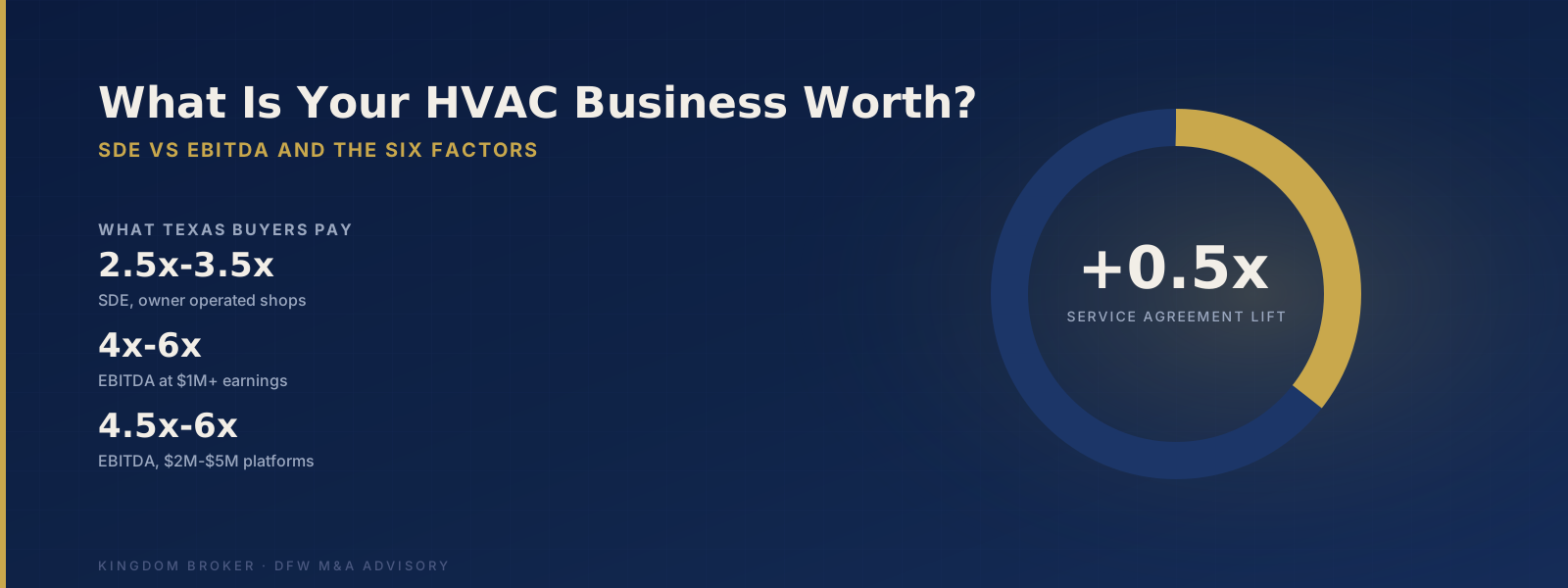
- Owner operated, under $500K SDE: 2.5x-3.5x SDE
- $500K-$1M in earnings: 3x-4x, depending on how removable you are
- $1M+ adjusted EBITDA: 4x-6x EBITDA, where private equity starts competing
- $2M-$5M EBITDA: 4.5x-6x when recurring revenue is strong
Why the spread inside each band? Two companies with identical earnings can sell a full turn apart. The difference is the six factors below.
One rule that surprises owners: your trucks, tools, and equipment are inside the multiple, not added on top. FF&E transfers with the business. Real estate is the opposite. Your building gets valued separately, on top of the business price. Always look at your number both ways, with the property and without it.
The Six Factors That Move Your Number
1. Recurring service agreements
Maintenance memberships are the single strongest lever in HVAC. A healthy agreement book can add half a turn or more to your multiple, because buyers pay up for revenue they can count on before the season starts.
2. Owner dependency
If the company cannot run for 30 days without you, the buyer is not buying a business. They are buying your job. It is the fastest discount in the market, and we wrote about the fix in how owner dependency kills business value.
3. Customer mix
A base of thousands of residential service customers beats three general contractors who each control a third of your revenue. Buyers stress test customer concentration early, and new construction exposure gets priced more cautiously than service work.
4. Your bench and your fleet
Licensed techs with tenure are worth real money in a market this tight. And since equipment sits inside the multiple, a tired fleet does not show up as a line item discount. It quietly pulls the whole multiple down.
5. Clean financials
Monthly P&L statements, real job costing, and books that match your tax returns. Buyers in the $1M+ EBITDA range will commission a quality of earnings review, and sellers who prepared for it keep their price.
6. The growth story
DFW keeps adding people, roofs, and heat. Buyers pay for provable runway: a replacement backlog, a lead flow you can point to, and the capacity to add trucks without breaking dispatch.
What Buyers Will Try to Deduct
Every offer arrives with a pencil. Expect buyers to press on a few standard deductions, and prepare for them before they come up.
- Working capital. Most deals above $1M in EBITDA include a working capital target. Sloppy receivables become your problem at closing, not theirs.
- Deferred fleet maintenance. If the trucks need $150K of catch up work, that money comes from somewhere. Usually your price.
- Unearned agreement revenue. Memberships collected but not yet serviced transfer as a liability. Clean tracking keeps the number small.
- Warranty exposure. Open warranty work gets estimated and reserved. Good records shrink the reserve.
None of these kill a deal. Surprises do.
What About Your Building?
Say your company earns $1.4M in adjusted EBITDA and commands 4.5x. That is a $6.3M business. If you also own the shop and it appraises at $850K, the deal is $6.3M plus the real estate, roughly $7.15M together.
You can also keep the building. Buyers will set a market rent, adjust earnings for it, and value the company on the rent adjusted number. You walk away with the business proceeds plus a tenant that pays you every month. Plenty of Texas owners treat the shop as their retirement income.
When Should You Get a Number?
Before you think you need one. Texas HVAC values move with your trailing twelve months, and a strong summer can lift the entire calculation. Owners who get a valuation in the fall, after the season proves out, negotiate from strength all winter.
The bigger reason is runway. Almost every factor above takes 12-24 months to improve. You cannot build an agreement book or develop a service manager in the month before you list. The owners who exit best treat their first valuation as a baseline, not a verdict. They get the number early, work the six factors, and come back to market with proof.
So How Much Is Your HVAC Business Worth? Run the Math
Take a shop with $480K in SDE. At 2.5x-3.5x, the range is $1.2M to $1.68M before the real estate. A company with $1.4M in adjusted EBITDA at 4x-6x frames between $5.6M and $8.4M. Wide ranges, and that is the point. The six factors decide where you land inside them.
Remember what a range is. It is a starting point, not an offer. Buyers price risk, structure, and terms, and the market gets the final vote. If you want the deeper mechanics, our full HVAC business valuation guide breaks down the math line by line, and when you are ready for the process itself, start with how to sell your HVAC business in Dallas-Fort Worth.
One more thing. You are not just pricing a company. You are stewarding years of early mornings, hard summers, and payroll made on faith. Getting the number right is part of honoring all of it.
Get Your Real Number
Free, confidential HVAC valuation built on live DFW comps. Know what your company is worth before a buyer tells you.
Get Your Free Valuation