How Do Pool Service Contracts Affect Your Sale Price?
If you own a pool service route in DFW, you already know the difference between a full book of weekly contracts and a pile of one-time repair calls.
One builds a business. One builds a job.
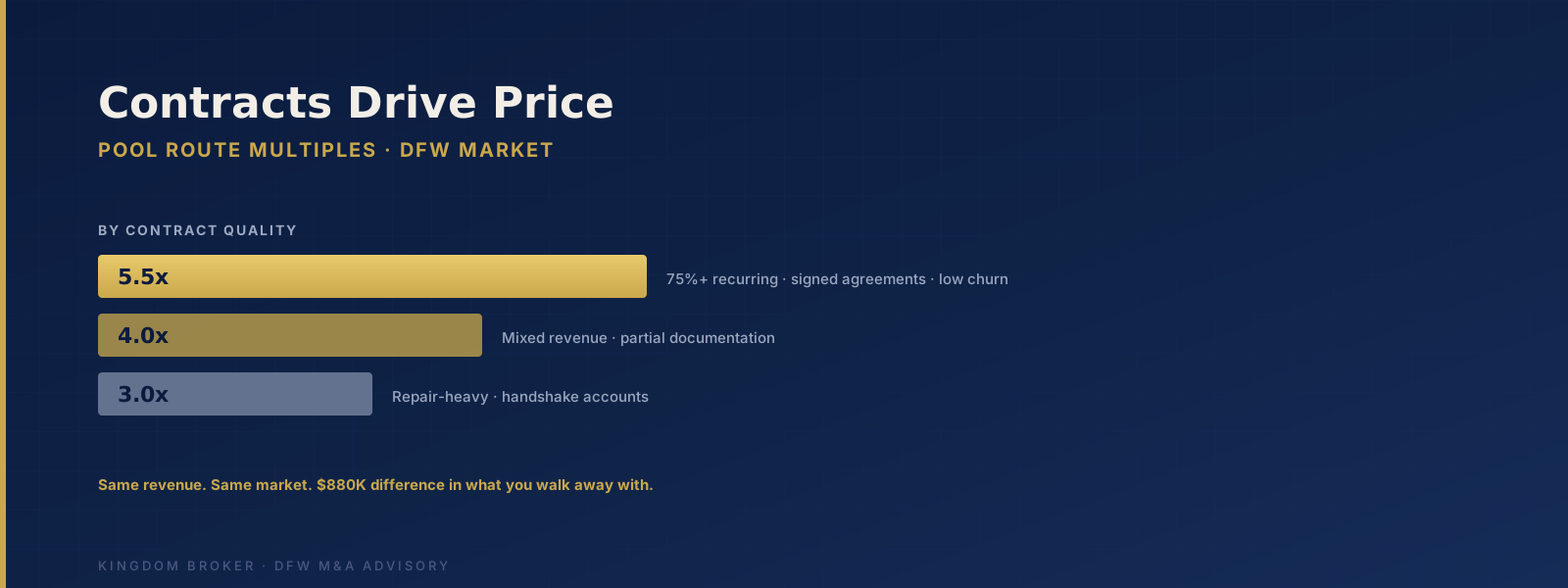
Buyers know the difference too, and they pay accordingly. The gap between a contract-heavy pool company and a repair-first operation isn't cosmetic. It's the difference between a 3x multiple and a 5.5x multiple on your Seller's Discretionary Earnings. On a $400K SDE business, that's $880,000 sitting on the table.
Let's walk through exactly how contracts get priced, what buyers look for, and what you can do about it before you list.
Why Recurring Revenue Changes Everything
Private equity groups and strategic acquirers, the buyers who write the biggest checks, think in terms of predictability. They're not gambling on whether your phone rings next March. They want to know that 340 customers in Frisco, Prosper, and McKinney have already committed to weekly service, and that 85% of them will still be there next March.
That predictability is what turns a blue-collar service route into an asset that looks, in a buyer's model, closer to a software subscription than a truck-and-bucket operation.
The math is straightforward: a pool route generating $1.2M in annual recurring contract revenue, with low churn and documented customer agreements, will trade at a meaningfully higher multiple than one generating $1.2M where 40% of that comes from irregular repairs and remodels.
Same top line. Very different value.
The Three Contract Metrics Buyers Actually Underwrite
1. Recurring Revenue as a Percentage of Total Revenue
Buyers want to see recurring weekly or bi-weekly service contracts represent at least 60% of your total revenue. The best deals, the ones commanding 5x and above, often show 75-85% recurring. If you're below 50%, expect pushback, lower multiples, or an earnout structure that puts more of your payout at risk.
This is the single most controllable lever you have before a sale. Deliberately shifting repair revenue toward maintenance agreements in the 12-24 months before going to market can meaningfully move your number.
2. Monthly Churn Rate
DFW pool routes lose customers. People move. They buy a house with a different setup. They cancel because their kid went to college and the pool sits empty. That's normal. But what buyers model is your monthly churn rate, and anything above 2-2.5% per month starts to look like a leaky bucket.
Best-in-class DFW pool companies run sub-1.5% monthly churn. That's roughly 15-18% annual turnover, which sounds high until you realize most routes are replacing those accounts organically. If you can document low churn, ideally with a CRM export that shows customer tenure, you've just handed a buyer their underwriting case for paying a premium.
High churn does the opposite. It signals service quality problems, pricing instability, or a customer base that wasn't really committed. A buyer paying $1.5M for your route doesn't want to watch 25% of the revenue walk in year one.
3. Contract Documentation and Transferability
This one catches a lot of DFW pool operators off guard.
You may have 400 weekly accounts. But if those accounts exist as nothing more than a name in a spreadsheet and a handshake, they're not contracts, they're relationships. And relationships don't always transfer when ownership changes.
Buyers want to see signed service agreements. They want to see that those agreements have an assignment clause allowing ownership to transfer without triggering customer cancellation. If your paperwork is thin, get ahead of it. Moving 60-70% of your route onto a formal agreement before you go to market is absolutely achievable and absolutely worth the effort. A broker who focuses on preparing your business for sale will tell you the same thing.
What Price Per Contract Actually Looks Like in DFW
The old rule of thumb was $1,000-$1,500 per residential pool account. That's outdated. The DFW market has tightened, population growth has pushed demand for routes, and strategic buyers are competing harder for quality inventory.
In today's market, here's a realistic range:
- Low-documentation, high-churn routes: $800-$1,200 per account
- Standard routes with some agreement coverage: $1,200-$1,800 per account
- High-documentation, low-churn, majority-agreement routes: $1,800-$2,500 per account
- Institutional-quality routes with CRM, low churn, and transferable contracts: $2,500+ per account
That spread: $800 to $2,500+ per account, tells you everything about how much documentation and retention are worth in real dollars.
If you want to understand what PE-backed buyers are actually underwriting, it's almost always contract quality and retention data before anything else.
The Repair Revenue Question
Repair and renovation revenue isn't bad. A pool company that does strong equipment replacement work on its own route customers is often more profitable than one doing pure maintenance. The issue is how buyers model it.
Repair revenue is typically given a lower multiple, sometimes valued separately as a one-time earnings stream rather than a recurring one. Some buyers apply a blended multiple that weights contract revenue higher and repair revenue lower. Others will simply haircut the total EBITDA figure to account for the variability.
This is one of the places where add-back conversations and quality-of-earnings analysis matter. A quality of earnings report will separate your revenue streams and help a buyer underwrite each one appropriately, which is better than having a buyer lump everything together and discount the whole business.
Owner Dependency and the Route Manager Problem
One more thing buyers are watching: who actually runs the route?
If you're in the truck three days a week and customers have your personal cell number, you have an owner-dependency problem. When you sell, some of those customers may not renew with the new owner. Buyers price that risk in, usually with a lower multiple or a heavier earnout.
Transitioning to a route manager model, where trained technicians run the accounts and the owner manages the business, does two things. It makes the sale cleaner. And it signals to a buyer that the contracts are real assets, not just an extension of your personal relationships. Owner dependency is one of the most consistent value killers we see in DFW service businesses, and pool routes are no exception.
The Timeline Reality
If you're two years out from selling, you have time to fix most of this. Shift repair customers toward maintenance agreements. Get signatures. Reduce churn by investing in service quality and simple retention outreach. Build a management layer that can run routes without you.
If you're six months out, focus on documentation. Get your existing accounts onto paper. Clean up your CRM. Pull a customer tenure report. You can't fix churn in six months, but you can present what you have in the most compelling light possible.
Either way, the first step is knowing where you actually stand. That means running real numbers, not gut estimates. Our free valuation tool is built for DFW service businesses and will give you a baseline before you talk to anyone.
Your route is worth more than you think, if the contracts back it up.
Find Out What Your Route Is Actually Worth
Get a free, no-pressure valuation built for DFW pool and home service businesses. Know your number before you talk to anyone.
Get Your Free Valuation