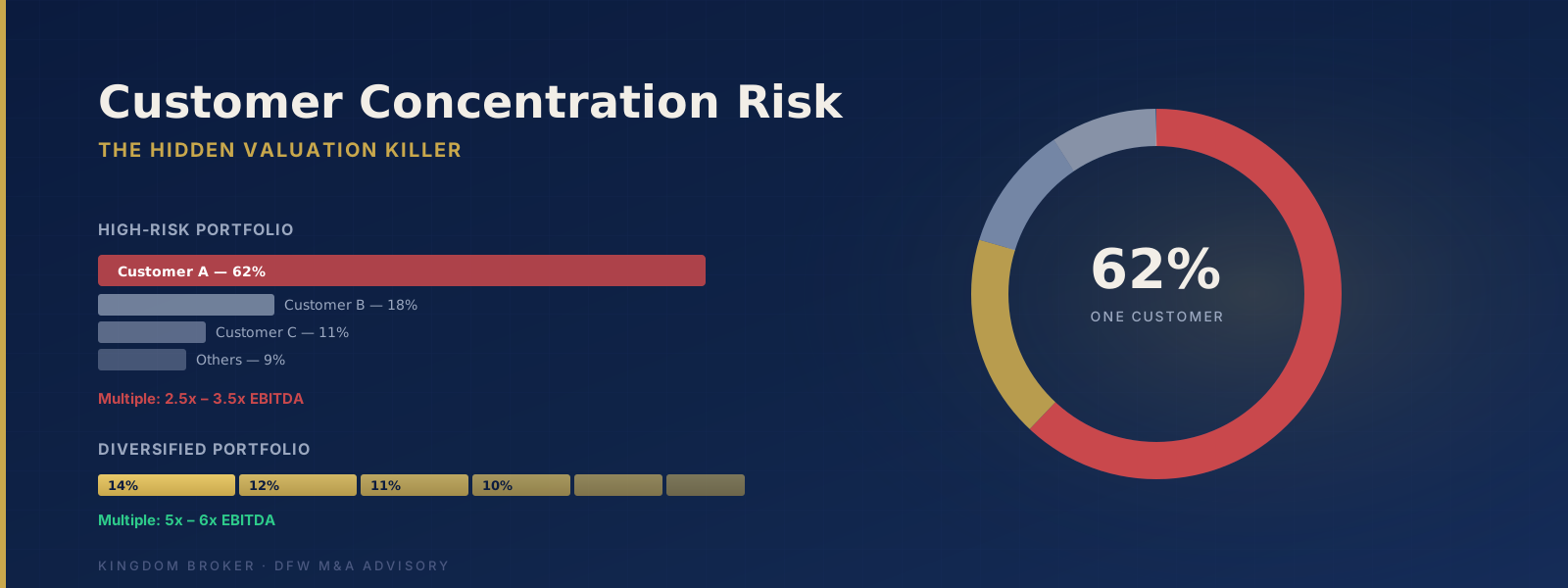
Customer Concentration Risk: The Hidden Killer of Your Business Sale Price
Every owner I sit down with in DFW tells the same story. "I have one customer who has been with me forever. They love us. They will never leave."
That customer is also the reason a buyer will pay you 30% less for the business.
Welcome to customer concentration risk, the second biggest valuation killer in lower middle market M&A, right behind owner dependency. It is quiet, it feels like a strength, and it costs DFW owners millions every year at the closing table.
What Is Customer Concentration Risk?
Customer concentration risk is the danger that too much of your revenue lives inside too few customers. If your top account walks after a sale, the buyer is holding a business that just lost 40% of its revenue overnight. Every buyer and lender knows this. They price it in long before they hand you a term sheet.
It is not just about one whale either. Buyers look at three numbers:
- Top customer percentage, how much revenue your single biggest customer represents
- Top 5 customer percentage, how concentrated your revenue is across the top five
- Customer churn and tenure, how long your top customers have stayed and whether anyone has left recently
The first number gets all the attention. The second one is where deals quietly die.
The 10 / 20 / 30 Rule Every DFW Owner Should Know
Here is the rule of thumb every banker, broker, and private equity associate uses when they scan a CIM:
Your business is diversified. Buyers pay a market or premium multiple. SBA lenders approve quickly. This is the goal.
One or two customers in this range is fine if the relationship is sticky, contracted, and diversified across decision makers inside the customer. Expect a few sharper diligence questions but no major discount.
Buyers start carving the offer. Expect a 0.5x to 1x reduction in your EBITDA multiple, an earn-out tied to retaining the customer, or a holdback in escrow until 12 months post-close.
SBA 7(a) lenders typically will not underwrite the deal. Private equity will model a sharp revenue decline scenario. Strategic buyers will demand a structured deal where most of the consideration is contingent on the customer staying. Multiple drops by 1x to 2x.
How Buyers Actually Measure It
During quality of earnings, your top customers are pulled into a separate analysis. The buyer's accounting firm rebuilds your last 36 months of revenue by customer. They want to see:
- Top 10 customers ranked by revenue, with each year side by side
- Tenure of each top customer
- Contract length and renewal terms
- Whether each customer has multiple decision makers or relies on one champion
- Industry of each customer (concentration inside one vertical is its own risk)
- Recent customer losses, even small ones, going back 3 years
Then the buyer runs the obvious thought experiment. "If we lose customer one, what happens to the business?" If the answer is "we go from $1M EBITDA to $300K EBITDA," they are not buying a $5M business anymore. They are buying a $1.5M business with optionality.
The Financial Impact: What It Costs You
Same DFW services company, two concentration profiles
Revenue: $5,000,000 · EBITDA: $1,000,000
High concentration: Top customer = 38% of revenue. Top 5 = 71%. One handshake renewal, no contract.
Multiple: 3x-3.5x
Value: $3,000,000 to $3,500,000
Deal structure: 60% cash at close, 40% earn-out over 24 months tied to top customer retention.
Healthy concentration: Top customer = 9% of revenue. Top 5 = 32%. Multi-year contracts on the top 3.
Multiple: 5x-6x
Value: $5,000,000 to $6,000,000
Deal structure: 90% cash at close, no earn-out.
Difference at closing: $2,000,000 to $2,500,000. And the healthy version actually pays you in cash, not promises.
5 Ways to Reduce Customer Concentration Before You Sell
1. Acquire new accounts in adjacent verticals
The fastest way to dilute concentration is to grow the denominator. If your top customer is 40% of a $4M business, adding $2M of new revenue from different industries drops them to roughly 27%. That single move can lift your multiple by half a turn or more.
The trap most DFW owners fall into: they chase new revenue from the same vertical because it is comfortable. Buyers see right through this. Industry concentration is its own risk factor. Spread across at least 3 different end markets.
2. Lock your top customers into multi-year contracts
Concentration is not just about size. It is about durability. A 25% customer on a 3-year auto-renewing contract is worth dramatically more than a 25% customer on a handshake.
Push for: 3-year terms, auto-renewal clauses, defined exit notice periods (90 days minimum), price escalators tied to CPI, and most importantly, multiple touchpoints inside the customer. Get your team in front of their team. Move the relationship off of "the owner is the only person they know."
3. Build a referral engine to smooth out lumpy sales
If 80% of your new business comes from one referral source, you have a hidden concentration problem on the inflow side. Build a multi-source pipeline: outbound, content, partner referrals, and a tracked customer referral program. Three to five working channels signals that revenue is repeatable, not lucky.
4. Productize your service for recurring revenue
One-time project work creates customer concentration by design. Every big project distorts your top-customer numbers. Recurring revenue solves this. Service contracts, maintenance agreements, monthly retainers, managed services, anything that creates a base layer of dollars from many smaller customers.
This is the single biggest valuation multiplier for trades businesses we work with. An HVAC company with 800 service contracts at $300/year is fundamentally worth more than one with 4 big commercial accounts, even at the same revenue. Different math entirely.
5. Make your concentration risk less scary
Sometimes you cannot fix it in time. If you are months from market with one sticky anchor customer, do not hide it. Frame it.
- Get a multi-year contract in writing before the LOI
- Document tenure (a 17-year customer is a very different story than a 17-month one)
- Have the customer meet your buyer during diligence so the relationship transfers visibly
- Offer to roll some of your equity into the deal, signaling you believe the customer is staying
- Structure a fair earn-out that you would actually hit
Transparency plus structure can save the multiple. Hiding the concentration and letting the buyer find it in diligence will kill the deal.
How DFW Businesses Get This Right
The DFW owners who walk away with the highest multiples treat customer diversification like a 24-month project, not a panic move three months before the sale. They start when their oldest customer is 35% of revenue, set a target of 15% in two years, and build the sales engine to get there.
This is also why private equity buyers reward diversified businesses with platform multiples. They are not just buying your cash flow. They are buying optionality.
The 18-Month Timeline
If you are 18 months from wanting to sell, here is the playbook we run with clients:
- Months 1-3: Pull a clean top-20 customer report. Calculate top 1, top 5, top 10 concentration. Identify your 3-year revenue trend by customer. Build a target customer mix you want at closing.
- Months 3-9: Push contract renewals on top 3 customers. Hire one outbound sales rep dedicated to new verticals. Launch a referral program.
- Months 9-15: Track your monthly concentration ratios. Aim for top customer below 20%, top 5 below 50%. Begin productizing services into recurring revenue.
- Months 15-18: Stabilize. Document everything for the CIM. Get a fresh valuation reflecting the new concentration profile.
Owners who run this playbook routinely lift their sale price by 30 to 50 percent. The investment in sales and contracts is typically $150K to $250K. The return is in seven figures. There is no other lever in a business with this kind of ROI.
The Truth Most Brokers Will Not Tell You
Most brokers will not raise customer concentration risk until you are already under LOI. Then it becomes a price re-trade with no leverage. At Kingdom Broker, we surface this before we ever take a business to market. Sometimes that means delaying the sale 12 months. The math always wins. A delayed close at a better multiple beats a fast close that leaves $1.5M on the table.
The same applies to every part of preparing for sale. Buyers reward businesses that have already done the work.
What Is Your Customer Concentration Costing You?
Get a free, confidential valuation that factors in your concentration profile, recurring revenue mix, and ideal deal structure. No obligation. Built for DFW owners exiting between $1M and $20M.
Get Your Free Valuation