Business Broker Fees for HVAC Sales in Texas
You built a great HVAC business. You kept techs busy through brutal DFW summers. You answered calls at midnight during ice storms. And now someone's going to charge you 10% of everything you've built to hand it off?
That's the gut reaction most owners have when they first hear about broker fees. It's a fair reaction. But before you decide to go it alone, or pick the cheapest broker you can find, let's walk through what these fees actually mean, why the structure matters more than the percentage, and how to know when you're getting a deal versus getting taken.
The Baseline: How Business Broker Fees Are Structured
Most business brokers use some version of the Lehman scale, a sliding percentage that decreases as the deal size grows. The original Lehman formula looks like this:
- 5% on the first $1 million of deal value
- 4% on the second $1 million
- 3% on the third $1 million
- 2% on the fourth $1 million
- 1% on everything above $4 million
That structure made sense in the 1970s when it was invented. In today's lower-middle market, which is where most HVAC businesses in the Dallas Fort Worth area actually live, it's often been replaced by something more aggressive.
Modified Lehman: The New Standard
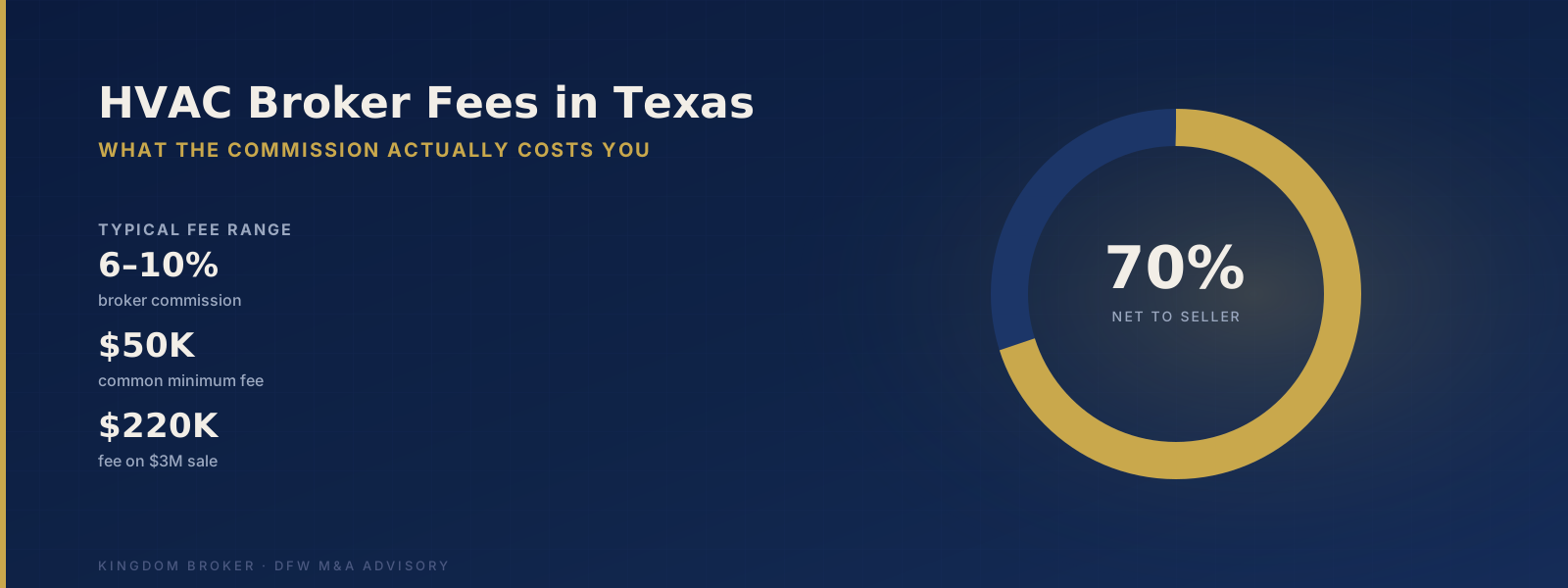
The modified Lehman scale doubles each tier. So instead of 5-4-3-2-1, you see 10-8-6-4-2. On a $2.5M HVAC deal, that math changes significantly. You're looking at a fee closer to $175,000-$220,000 rather than $110,000-$130,000 under the original scale.
That's not necessarily unfair, it depends entirely on what the broker actually does for the money. If they prep your financials, run a real process with qualified buyers, negotiate well, and get you to close, the fee is almost always worth it. If they post on BizBuySell and wait, it's not.
Double Lehman: When You Should Push Back
Some brokers working the sub-$1M end of the market charge a flat 10% with a minimum of $15,000-$25,000. Others call it the double Lehman and apply it straight across regardless of deal size. On a $4M HVAC business, that's $400,000 in broker fees alone, before attorney costs, QoE reports, and taxes.
At that size, you should be asking hard questions. A firm doing serious sell-side M&A advisory work in Texas, especially for a DFW HVAC business with real EBITDA and recurring revenue, should be able to justify their structure transparently. If they can't, that's a signal.
What Fair Looks Like for HVAC Sales in Texas
Here's what a reasonable fee structure looks like across the deal size range you're most likely to see in the DFW market:
- $1M-$2M sale price: 8%-10%, minimum $50,000-$75,000
- $2M-$5M sale price: 6%-8%, modified Lehman common
- $5M-$10M sale price: 4%-6%, sometimes with a retainer offset
- $10M-$20M sale price: 3%-5%, closer to investment banking territory
The HVAC industry specifically tends to land in that $2M-$7M sale-price range for owner-operated shops in Texas with $400K-$1.5M in adjusted EBITDA. That's the sweet spot where broker fees, if structured right, still make economic sense for both sides.
If you haven't pinned down what your business is actually worth before you talk fees, start with a free business valuation. You need a number before you can evaluate whether a fee is proportionate.
Retainers: What They Mean and When They're Fair
Some brokers and M&A advisors charge an upfront retainer, typically $5,000-$25,000 for businesses in the $2M-$10M range. This isn't automatically a red flag. It's actually a green flag in some cases.
A retainer tells you two things. First, the advisor is doing real work upfront, building a Confidential Information Memorandum (CIM), normalizing your financials, identifying qualified buyers. Second, they have some skin in the game on execution. Brokers who work purely on success fees are incentivized to get any deal done rather than the right deal at the right price.
That said, retainers should always be credited toward the success fee at closing. If a broker wants a non-refundable retainer that doesn't offset the back-end commission, walk away.
The Hidden Costs Owners Miss
The broker fee is the obvious line item. But it's rarely the only one. Here's what else eats into your net proceeds on an HVAC sale in Texas:
- Quality of Earnings (QoE) report: $8,000-$25,000 depending on complexity. Often required by buyers or their lenders. See what a QoE costs in DFW.
- Attorney fees: $10,000-$40,000 for a well-negotiated asset purchase agreement. Don't skip this.
- Tax prep and planning: An asset sale vs. stock sale decision can swing your net proceeds by six figures. Read more on tax implications when selling.
- Seller financing: Not a cost, but a risk, if 20%-30% of your deal is seller-carried, that's not cash in hand at closing. Understand what you're agreeing to before you sign.
A $3M gross sale price can net you anywhere from $1.9M to $2.5M depending on how these costs stack up. The broker fee is real, but it's rarely the biggest variable.
Broker Fee vs. Going It Alone
Some owners try to sell their HVAC business without a broker, especially if they have a known buyer, like a competitor or a key employee. That's worth considering. But there are risks most people underestimate.
First, buyers, especially private equity-backed buyers rolling up home services companies in Texas, have professional deal teams. You don't. That asymmetry almost always shows up in the final terms, not just the price but in reps and warranties, earnout structures, and working capital adjustments that can quietly claw back six figures post-close.
Second, a good broker creates competition. Competition creates leverage. Leverage creates better prices. Even one additional qualified buyer at the table can move a deal by 0.5x EBITDA, which on a $600K EBITDA business is $300,000. That more than covers the broker fee on most deals.
The broker vs. going solo question deserves serious thought. But for most HVAC owners in DFW, a well-run process with representation outperforms a private deal, even net of fees.
What to Ask Any Broker Before You Sign
Before you engage anyone, get clear answers to these questions:
- What is your exact fee structure, in writing?
- Is there a retainer, and does it offset the success fee?
- How many HVAC businesses have you sold in Texas in the last 24 months?
- How do you find buyers, and can you name the types of buyers in your network?
- What is your average days-on-market to close?
- What happens if the deal falls through, do I owe you anything?
A broker who hedges or gets defensive on any of these should concern you. This is a major transaction. You deserve straight answers.
The Kingdom Broker Perspective
We're transparent about our fee structure because we think the relationship has to start that way. We work with HVAC, plumbing, roofing, and other home-service businesses across the DFW market, typically in the $1M-$20M sale-price range. Our fees are success-fee-based with a clearly documented structure we'll walk through before you sign anything.
The goal isn't a transaction. It's a transition, one that reflects what you actually built, protects your team, and funds the next chapter of your life. That's what we mean when we talk about preparing your business for sale the right way.
If you want to understand what your HVAC business is worth before you ever talk fees, start there. A number gives you context. Context gives you leverage.
Find Out What Your HVAC Business Is Worth First
Before you talk fees, get a number. Our free valuation gives you the context you need to evaluate any broker, any offer, and any deal structure.
Get Your Free Valuation