Best Business Broker for Plumbing Companies in Texas
You've spent years building a plumbing business in Texas. The trucks are branded. The techs are licensed. The phone keeps ringing. And now you're wondering whether it's time to sell, and who on earth is going to help you do it right.
Most business brokers in Texas will take your listing. Few of them actually understand plumbing.
That gap matters more than you might think. The wrong broker costs you real money, on valuation, on deal structure, on how they explain your business to buyers. The right broker pays for themselves many times over.
Here's what you need to know before you hire anyone.
Why Plumbing Businesses Need a Specialist Broker
Plumbing isn't a generic service business. It has layers that most brokers either misunderstand or simply ignore when they're building your Confidential Information Memorandum (CIM).
Think about what's actually inside your company:
- Texas master plumber license, and what happens to it when you exit
- Journeyman and apprentice ratios that affect compliance
- Recurring revenue from service agreements versus one-time jobs
- Supplier relationships and material costs that swing margins
- Fleet age, condition, and whether it needs replacement before or after sale
- Municipal licensing in multiple DFW cities: Dallas, Fort Worth, Arlington, Plano, Frisco, and more all have their own requirements
A generalist broker sees a plumbing company the same way they see a dry cleaner or a sandwich shop. They plug your numbers into a multiple and call it a day.
A plumbing-savvy broker knows that your master license is a deal-stopper if it's not transferable. They know that buyers, especially private equity-backed platforms rolling up trades in DFW, will pay a premium for recurring service revenue but will discount hard for customer concentration. They know how to tell your story in a way that justifies your asking price.
The Master License Problem No One Talks About
Let's be blunt: the Texas State Board of Plumbing Examiners (TSBPE) requires every plumbing company to have a licensed master plumber as the responsible party on the company license.
If that master plumber is you, and you're leaving, the buyer has a problem on day one.
Some owners don't realize this until they're already in due diligence. By then, it's too late to negotiate calmly. A deal-experienced broker flags this on the first call. They'll ask whether you have a W-2 master plumber on staff who can take over the license, or whether the buyer needs to arrange for one before closing. They'll build a transition plan around it before it becomes a crisis.
This is exactly the kind of industry-specific complexity that separates a broker worth hiring from one who's just collecting a commission.
What Does a Good Plumbing Business Broker Actually Do?
The job is bigger than posting a listing on BizBuySell and waiting for emails.
A strong broker for your Texas plumbing company will:
- Build a realistic valuation based on actual plumbing industry comps, not just a generic 3x EBITDA
- Identify the right buyer pool: strategic acquirers, PE-backed platforms, owner-operators, and SBA-financed buyers
- Prepare a CIM that highlights recurring revenue, fleet quality, team structure, and geographic coverage
- Run a structured process that creates buyer competition, not a single conversation that gives away your leverage
- Guide you through due diligence without letting it kill your deal
- Negotiate deal structure, not just price, including earnouts, seller financing, and equity rollovers
The best brokers in this space have sold plumbing businesses before. They can name buyers. They know which PE platforms are actively acquiring in Texas right now. They've seen the license transition issue solve itself, and watched it blow up a deal. Experience in this specific industry is worth more than credentials on a wall.
Multiples: What Are Texas Plumbing Businesses Actually Selling For?
This is where the truth matters more than the pitch.
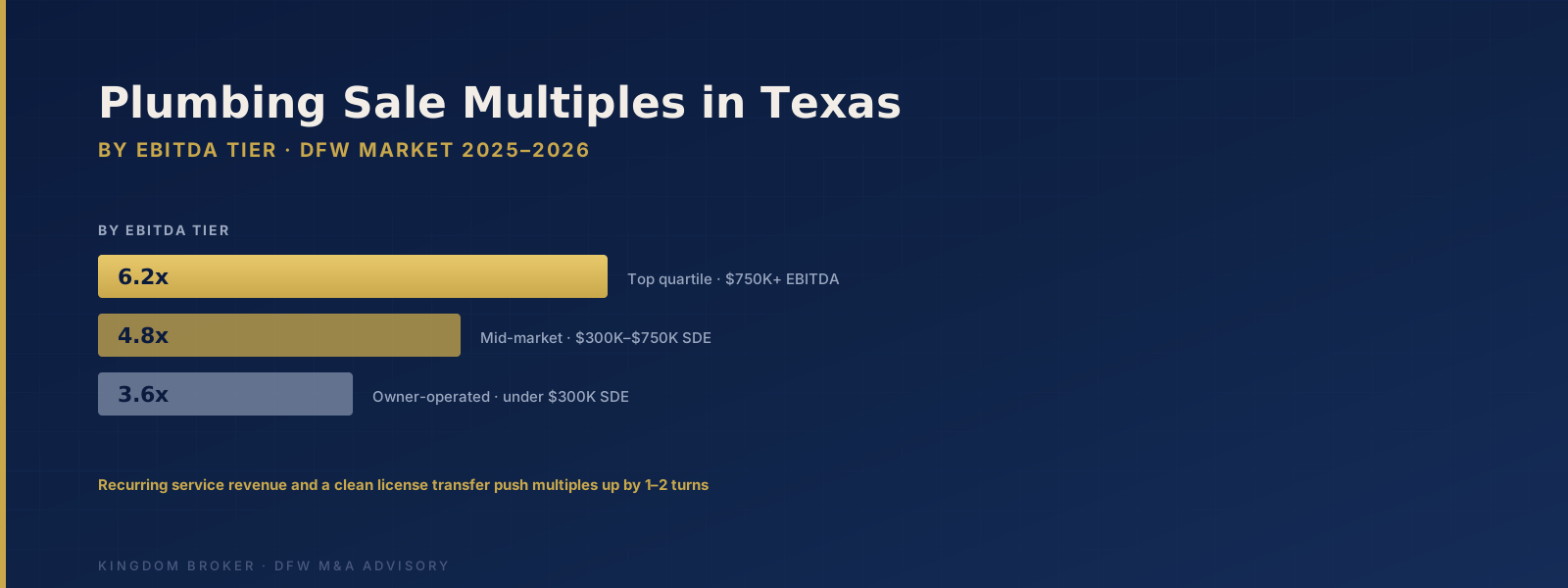
In the current DFW market, plumbing companies with strong fundamentals are trading in a range of 3.5x to 5.5x Seller's Discretionary Earnings (SDE) for owner-operated businesses under $3M in revenue. Larger businesses with real EBITDA, call it $750K and up, start attracting institutional buyers and can push into 5x to 7x EBITDA territory.
What moves you toward the top of that range? Recurring service agreements. Low customer concentration. A management team that doesn't depend entirely on you. Clean books. A transferable license situation. And a broker who knows how to position all of that in front of the right buyers.
What drags you toward the bottom? Everything that makes a buyer nervous about what happens after you leave. That's owner dependency. That's one big commercial client who represents 40% of revenue. That's a master plumber, you, who plans to walk out the door on day 61.
A good broker helps you fix the fixable things before you go to market. That alone can be worth hundreds of thousands of dollars.
Questions to Ask a Broker Before You Sign Anything
The first call with a broker is an interview, for both of you. Don't be passive. Come with real questions.
Ask about their plumbing deal history
How many plumbing businesses have they actually sold? In Texas? Recently? If they can't name a deal, they're learning on your dime.
Ask who the likely buyers are
A good broker shouldn't wait until after signing to start thinking about the buyer pool. They should already know which platforms are acquiring in DFW, which SBA lenders are active in the trades, and what owner-operators are looking for. Vague answers here are a red flag.
Ask how they handle the license transition
If they look confused, that's your answer. Move on.
Ask about their fee structure and engagement terms
Most lower-middle-market brokers charge a success fee, typically 8% to 12% at this deal size, sometimes with a small upfront engagement fee for prep work. Understand what you're signing and what happens if the deal doesn't close. Read the details on broker fees in Texas so you walk in informed.
Ask for their valuation methodology
Not just a number. A methodology. How are they calculating SDE? What add-backs are they including? What comps are they using? A broker who can't walk you through this clearly is a broker who will either overprice your business (bad for everyone) or underprice it (bad for you).
The DFW Advantage, and Why It's Real
Texas is one of the most active markets for home services M&A in the country right now. DFW is the epicenter. Population growth, new construction, aging housing stock, and a massive wave of retiring tradespeople has created a buyer's hunger that isn't slowing down.
That's good news for you. But only if you're working with a broker who knows how to access that demand, not just list your company and wait.
The best brokers in this market have existing relationships with buyers. They know which PE platforms just closed a fund and are actively deploying. They know which operators are looking for a second or third acquisition. They're not waiting for inbound leads. They're making calls.
If you want to understand what your plumbing business is actually worth in this market, before you talk to anyone, start with a free valuation. Get a number you can plan around. Then choose your broker from a position of knowledge, not hope.
Find Out What Your Plumbing Business Is Worth
Get a free, no-pressure valuation built on real DFW plumbing comps, before you talk to any broker, including us.
Get Your Free Valuation