Average Sale Price of an HVAC Business in DFW
You've built something real. A fleet of vans. A crew that shows up. A phone that rings every June when Dallas temps hit 100 degrees. Now you're wondering what it's actually worth to a buyer writing a check.
Good question. And it deserves a straight answer, not a range so wide it's useless.
Here's what we're seeing in the DFW HVAC market right now.
Why DFW HVAC Businesses Sell at a Premium vs. the National Average
The Dallas Fort Worth metro is one of the most active HVAC M&A markets in the country. Population growth, a relentless summer heat cycle, and a steady stream of new construction in Celina, Prosper, Mansfield, and Forney mean demand isn't theoretical. It's baked into the geography.
Private equity groups, strategic acquirers, and owner-operators moving up from smaller markets all compete for quality DFW HVAC businesses. That competition pushes prices up, when the business is ready for it.
National broker data often shows HVAC businesses trading at 2.5x-4x EBITDA across all markets. In DFW, a well-prepared business in the right revenue band can clear 4x-6x EBITDA. Some outliers go higher. But most deals don't hit those numbers, and we'll explain exactly why.
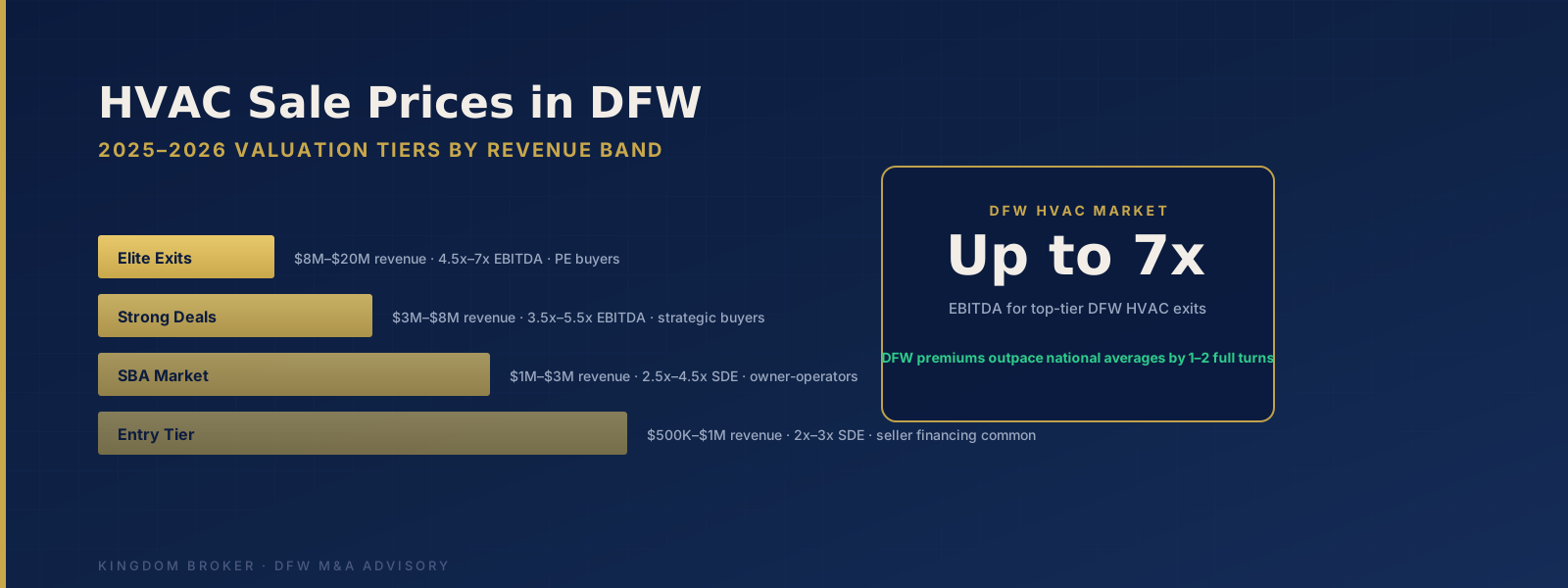
HVAC Sale Price by Revenue Band: DFW 2025-2026
These are real ranges based on closed transactions and current deal activity in North Texas. EBITDA multiples vary by deal structure, buyer type, and how clean the business is.
$500K-$1M in Annual Revenue
These are the smallest deals that typically attract financing. Sale prices usually land between $200K and $500K, often structured with seller financing because SBA lenders get cautious on businesses this size without strong documented earnings.
Multiples tend to be 2x-3x Seller's Discretionary Earnings (SDE), not EBITDA, because at this size, the owner IS the business. If you're pulling $250K in SDE and walking away, the buyer has to replace you. That risk gets priced in.
$1M-$3M in Annual Revenue
This is the most active buyer pool in DFW right now. SBA 7(a) loans are the most common financing vehicle, and buyers are motivated. Sale prices typically range from $400K to $1.5M.
Multiples here are 2.5x-4x SDE or 3x-4.5x EBITDA, depending on how much of the business runs without the owner. If you're still riding the truck and your name is the only one customers trust, you'll land at the lower end. If you have a service manager and a dispatcher and documented processes, you'll push toward the top.
Learn more about how owner dependency affects your business value before you start talking to buyers.
$3M-$8M in Annual Revenue
This is where the deal gets interesting. You're now in range for private equity platform acquisitions and regional strategic buyers who want your customer list, your techs, and your brand in a specific DFW corridor, maybe Southlake, Frisco, or the mid-cities.
Sale prices typically fall between $1.5M and $5M. Multiples: 3.5x-5.5x EBITDA. The ceiling rises fast if you have recurring revenue, maintenance agreements, service contracts, commercial accounts with annual renewals. Buyers pay a real premium for predictable cash flow.
This tier also starts to attract private equity firms looking for add-on acquisitions to bolt onto an existing platform. Those buyers move fast and pay well, but they also dig deep in due diligence.
$8M-$20M in Annual Revenue
You're a platform. PE groups, family offices, and large regional operators are your buyer universe. Sale prices in this range can reach $5M to $15M or more, with EBITDA multiples running 4.5x-7x for the cleanest businesses.
At this level, buyers will commission a full Quality of Earnings report before closing. They want verified, normalized EBITDA, not your P&L at face value. Your add-backs need to be bulletproof. Your customer concentration needs to be low. And your management team needs to be able to run the operation whether you're in the building or in Cabo.
What the Top 10% of DFW HVAC Sales Had in Common
We've seen enough deals close, and enough deals fall apart at the finish line, to know what separates a 5x exit from a 3x exit. It's not luck. It's preparation.
The sellers who got the best prices in 2024-2025 shared a few consistent traits:
- Three or more years of clean, consistent financials with tax returns that matched their P&Ls
- Documented recurring revenue, maintenance agreements or commercial service contracts covering at least 20% of annual revenue
- A management layer that existed before the sale process started
- Customer concentration below 15% from any single account
- A defined service territory with a brand buyers could actually acquire, not just a phone number
If your business checks three of those five, you're competitive. If it checks all five, you're in the top tier.
If you're not sure where you stand, take a hard look at how to prepare your HVAC business for sale before you list.
Deal Structure Matters as Much as the Multiple
Here's the part that surprises a lot of sellers: two deals at the same multiple can leave you with very different amounts of cash.
A $2M all-cash deal at closing is not the same as a $2.5M deal where $800K is tied to a two-year earnout. Earnouts can be legitimate, or they can be a way to push risk back onto the seller. Know the difference before you sign.
Seller financing is also common in the $1M-$3M range. Done right, it can actually improve your total proceeds and help a qualified buyer get to your number. Done wrong, it's a receivable you'll spend two years trying to collect.
Understanding add-backs and how they affect your stated EBITDA is equally critical. The difference between $350K and $500K in normalized earnings can be $750K in sale price at a 5x multiple. Real money. Worth getting right.
The Honest Truth About Where Most Deals Land
Not every HVAC business sells at the top of the range. That's just the truth.
Most DFW HVAC businesses that hit the market in 2025-2026 have sold at 2.5x-4x SDE. The ones that couldn't document their earnings, had the owner answering 80% of service calls, or carried one commercial account that represented half their revenue, those are the deals that underperformed or didn't close at all.
The market is strong. Demand is real. But buyers have options, and they know how to spot a business that looks bigger on the surface than it actually is.
If you want to know where your HVAC business actually stands, not a guess, a real number based on your financials and current DFW buyer demand, get a free valuation estimate here. It takes less than five minutes and we'll give you a straight answer.
Find Out What Your HVAC Business Is Actually Worth
Get a free, no-fluff valuation estimate based on your real numbers and current DFW buyer demand. Takes five minutes.
Get Your Free Valuation