Why Waste Management Businesses Command Premium Valuations
Waste management is one of the most desirable sectors in small business M&A right now. Every municipality, business park, construction site, and residential community needs reliable waste collection. That need does not disappear in a recession. When the economy contracts, waste still has to go somewhere.
What makes waste hauling businesses so attractive to buyers? Three factors dominate. First, waste businesses generate long-term recurring contracts with automatic price escalation clauses, municipal commitments, and high renewal rates. These look like annuities to a buyer. Second, the industry has high barriers to entry, you need equipment, permits, transfer station access, and established routes. A competitor cannot just open up next door. Third, the market is highly fragmented, with thousands of independent operators serving their local regions, making it perfect for roll-up consolidation.
Waste businesses selling today are entering a market flooded with buyer appetite. Large strategic players like Waste Connections, GFL Environmental, and Republic Services are aggressively acquiring smaller operators. Private equity platforms are rolling up regional haulers and building platform companies worth hundreds of millions. For owners who understand their value, this is a generational opportunity.
$100B+
U.S. waste management market size, with PE capital actively deploying
4.0-8.0x
typical EBITDA multiple range for waste businesses ($1M-$20M revenue)
2,000+
independent waste operators targeted for consolidation by PE platforms
The window for owners to sell into this wave is open now. As consolidation accelerates and platforms become larger, independent haulers with strong routes and contracts will become increasingly valuable. The question is not whether to sell, but how to sell at a price that reflects what you have built.
 Commercial Waste
Residential Routes
Operations
Waste Management EBITDA Multiples: What Buyers Actually Pay
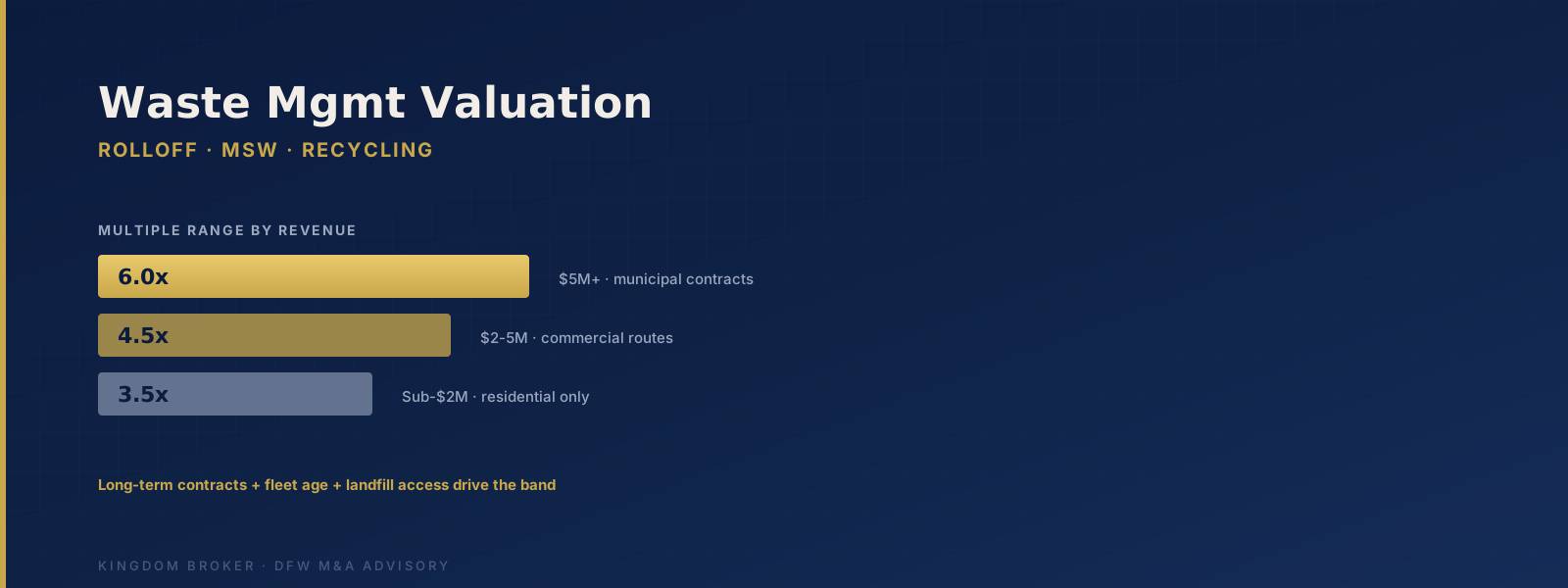
The standard way buyers value a waste management business is by applying a multiple to adjusted EBITDA. Waste multiples are significantly higher than most other small business industries because of the combination of recurring revenue, essential services, and consolidation opportunity. Understanding the multiple range for your specific business profile is critical to knowing what you should expect at sale.
Multiples vary based on business size, contract composition, route density, customer diversification, and operational efficiency. Here is how the ranges break down for waste haulers:
Notice the higher floors compared to most industries. A small waste operator at 4.0x is roughly equivalent to a small HVAC operator at 2.5x because of the stability and recession-proof nature of waste. These multiples are drawn from closed transactions in 2024 and 2025, both strategic acquisitions and PE roll-ups. Multiples apply to normalized EBITDA, which includes add-backs for owner-specific expenses. Properly normalizing your EBITDA can add hundreds of thousands of dollars to your valuation.
"A waste hauler at 6.5x EBITDA versus 5.0x is a difference of $900K on $900K of normalized earnings. Contract length and route density are the value drivers that move that needle."
The 6 Value Drivers for Waste Management Businesses
Two waste haulers with identical revenue and EBITDA can sell for dramatically different prices. The difference comes down to the operational and contractual characteristics that buyers analyze as sources of value creation or risk. Understanding these drivers lets you know where to focus before going to market.
📋
Contract Length and Renewability
Multi-year contracts with automatic renewals and price escalators are gold to buyers. Municipal contracts with 3 to 5 year terms and 90%+ renewal rates create visibility and reduce churn. Spot pricing or month-to-month residential routes are riskier. Longer contract tails = higher multiple.
🗺️
Route Density and Logistics
Tightly clustered residential and commercial routes in a defined geography reduce fuel costs, labor time, and vehicle wear. Buyers calculate cost per ton and per pickup. Efficient route density is a primary lever for post-acquisition cost reduction. Inefficient routes signal inefficiency.
🏭
Transfer Station Access
Owning or controlling a transfer station eliminates tipping fees, creates a secondary revenue stream, and provides operational control. Buyers view this as valuable infrastructure. Dependence on third-party facilities creates cost risk and reduces profitability.
👥
Customer Diversification
If 30% or more of revenue comes from a single customer or municipality, that is concentration risk. Buyers want balance across residential, commercial, construction, and municipal work. Diversified customer base = lower churn risk = higher multiple.
🚛
Fleet Age and Maintenance
Modern, well-maintained equipment reduces downtime, maintenance costs, and regulatory risk. Older fleet = higher capex needs post-acquisition = lower multiple. Buyers analyze age of each vehicle, replacement reserve, and maintenance history.
✓
Environmental and Regulatory Compliance
Clean permitting history, DOT compliance, EPA records, and local waste permits are essential. Environmental liabilities or compliance gaps create deal risk and can kill acquisitions. Clean regulatory status is table stakes.
Waste Management Valuation: A Real-World Walk-Through
Here is how a typical waste business valuation works in practice. Consider a fictional regional hauler called Texas Sanitation Services, operating in the Dallas metro area.
Example: Texas Sanitation Services, Dallas Metro TX
Revenue (TTM): $5.2M | Reported EBITDA: $1.1M | Years in Business: 18
Owner Comp: $260K (market rate GM: $120K) | Truck Fuel: $32K/yr personal | Contract Revenue: 65% multi-year municipal/commercial
Fleet Age: 3.2 years average | Route Density: High (Dallas metro) | Transfer Station: Owned
Step 1: Calculate Normalized EBITDA
Start with reported EBITDA of $1,100,000. Then add back owner-specific expenses:
- Excess owner compensation: $260K - $120K = $140,000 add-back
- Personal fuel/vehicle: $32,000 add-back
- One-time truck purchase: $25,000 add-back (non-recurring)
Normalized EBITDA: $1,100K + $140K + $32K + $25K = $1,297,000
Step 2: Apply the Multiple
Texas Sanitation has 65% long-term contract revenue, modern fleet, owned transfer station, strong route density in a growing market, and a solid operations team. Based on the $5M revenue tier with strong fundamentals, a reasonable multiple range is 6.0x to 7.5x normalized EBITDA.
- Low estimate: $1,297K × 6.0 = $7,782,000
- Mid estimate: $1,297K × 6.75 = $8,754,750
- High estimate: $1,297K × 7.5 = $9,727,500
That is a valuation range of approximately $7.8M to $9.7M. Without the add-backs, the same company at the same multiples would have valued at $6.6M to $8.25M. The normalized EBITDA work added $1.2M+ to the top end valuation. This is why precise financial analysis matters.
Want to run your own numbers? Our free business valuation tool walks you through this process with real industry multiples. It takes under five minutes and requires no login.
Deal Structures for Waste Management Business Sales
Knowing your valuation is step one. Knowing how the deal gets structured determines what you actually receive. The three most common structures for waste acquisitions in the $1M-$10M range are SBA financing, strategic acquisition with earnouts, and PE roll-ups with equity retention.
SBA 7(a) Financing
For smaller waste operations (under $3M), SBA 7(a) is common. The SBA guarantees the bank loan, allowing buyer to purchase with 10-20% down. For you, SBA structures mean buyer has bank support and can pay a higher price. The key requirement is three years of clean tax returns showing stable cash flow. If your books are solid, positioning your deal as SBA-eligible expands your buyer pool.
Strategic Acquisition with Earnouts
Larger strategic buyers like Waste Connections or GFL often structure deals with an earnout component. You get 60-70% at closing, with 20-30% held in escrow or payable over 2-3 years based on customer retention and revenue targets. While earnouts feel uncertain, they can push total consideration higher than an all-cash deal. Strategic buyers pay premiums for route consolidation and customer acquisition.
PE Roll-Up with Equity Retention
PE platforms are increasingly buying waste operators and rolling them into consolidation vehicles. They may offer an all-cash price for 70-90% of your business, with you retaining 10-30% equity in the platform. The equity upside can be significant if the platform adds multiple other haulers and sells to a larger buyer or goes public. This structure rewards operational excellence and aligns your interests with growth.
Why Private Equity Is Buying Every Waste Company It Can Find
Waste management has become one of the most active sectors in PE roll-up strategies. Here is why:
Fragmentation. The waste industry has thousands of small operators, but is consolidating rapidly. A single PE platform can acquire 20, 30, or 50 independent haulers in a region and achieve meaningful synergies.
Cost synergies. Consolidate fleet maintenance. Leverage transfer station capacity. Renegotiate supplier contracts across multiple companies. Optimize routes. Combine back-office operations. These moves can improve EBITDA margins by 2 to 5 percentage points.
Pricing power. As the platform gets larger, it gains leverage with municipalities and commercial customers. Customers renewing contracts on a consolidated platform may see modest price increases, which flow directly to EBITDA.
Exit potential. A platform with $50M+ in revenue and 3-5x EBITDA becomes attractive to larger strategic buyers or can be sold to other PE firms. The holding periods are typically 4 to 7 years before a secondary exit.
If you are approached by a PE firm or search fund operator, understand the platform thesis. How many other companies do they plan to add? What are their cost reduction targets? What is the exit strategy? The answers will tell you whether this buyer can pay a premium and help you decide if equity retention makes sense.
Frequently Asked Questions About Waste Business Valuation
What EBITDA multiple do waste management businesses sell for?
Waste businesses typically sell for 4.0x to 8.0x adjusted EBITDA, depending on size, contract type, and operational efficiency. Smaller owner-operated haulers trade at 4.0x-5.5x, while larger companies with long-term municipal contracts and efficient operations command 6.0x-8.0x or higher. This is significantly higher than most other small business sectors due to recurring revenue and consolidation opportunity.
How do contract length and type affect waste business valuation?
Contract length and type are critical. Long-term municipal contracts (5+ years) with automatic renewals and price escalators create revenue visibility that buyers love. Multi-year commercial contracts also add stability. Conversely, businesses dependent on spot pricing and month-to-month residential routes are riskier. A waste hauler with 70% long-term contract revenue can command a 1.0x to 1.5x higher multiple than one relying on spot pricing.
What makes a waste management acquisition attractive to PE firms?
Private equity targets waste for three reasons: recurring revenue, consolidation opportunity, and cost synergies. They can buy multiple independent operators in a region, combine their routes and back offices, eliminate duplicate costs, and improve margins. A single platform might acquire 20 haulers over 3 years, cut combined overhead by 15-20%, and exit for a significant premium to the aggregate purchase price.
How important is transfer station access to waste business value?
Critical. Owning or controlling a transfer station eliminates tipping fees, creates a revenue stream, and provides operational leverage. It signals to buyers that you have built infrastructure, not just routes. A waste hauler with transfer station access can command 0.5x to 1.0x higher multiples than one dependent on third-party facilities. Buyers view infrastructure ownership as a significant moat.
Should I consider a strategic or PE acquisition?
Strategic buyers like Waste Connections pay premium prices for bolt-on acquisitions that fit their platforms. They move quickly and integrate operations. PE buyers may offer slightly lower initial prices but often include equity rollovers and growth upside. Your decision depends on timeline (strategic = faster), risk tolerance (strategic = lower), and whether you want to stay involved post-sale (PE = yes, strategic = usually no).
Build Your Valuation Before You Talk to a Buyer
You did not build a waste management business by accident. Every route, every contract renewal, every piece of equipment is part of a system that serves your community and generates cash. That has value, significant value. But only if you can demonstrate it to a buyer.
The owners who get the best outcomes understand their financials, know their value drivers, and come to market prepared. Whether you are five years from selling or ready to explore options now, start by knowing your number.
Our free business valuation tool uses real 2025-2026 waste industry multiples and walks you through normalized EBITDA calculation. It takes less than five minutes and requires no login. Run your numbers and see what your waste business is worth through a buyer's eyes.
Free: Takes 5 Minutes
See What Your Waste Business
Is Worth to a Buyer
Use real 2025-2026 EBITDA multiples from the waste management industry. Get a personalized valuation range based on your actual financials and the value drivers that matter most.
Confidential · No obligation · Nationwide coverage