Pool Service Customer Concentration: Routes & Risk
You built a great route. Maybe 180, 200 weekly stops across Frisco, McKinney, Southlake, or Keller. The trucks run clean. The techs show up. Revenue is strong.
And then a buyer's advisor pulls your top-10 customer list.
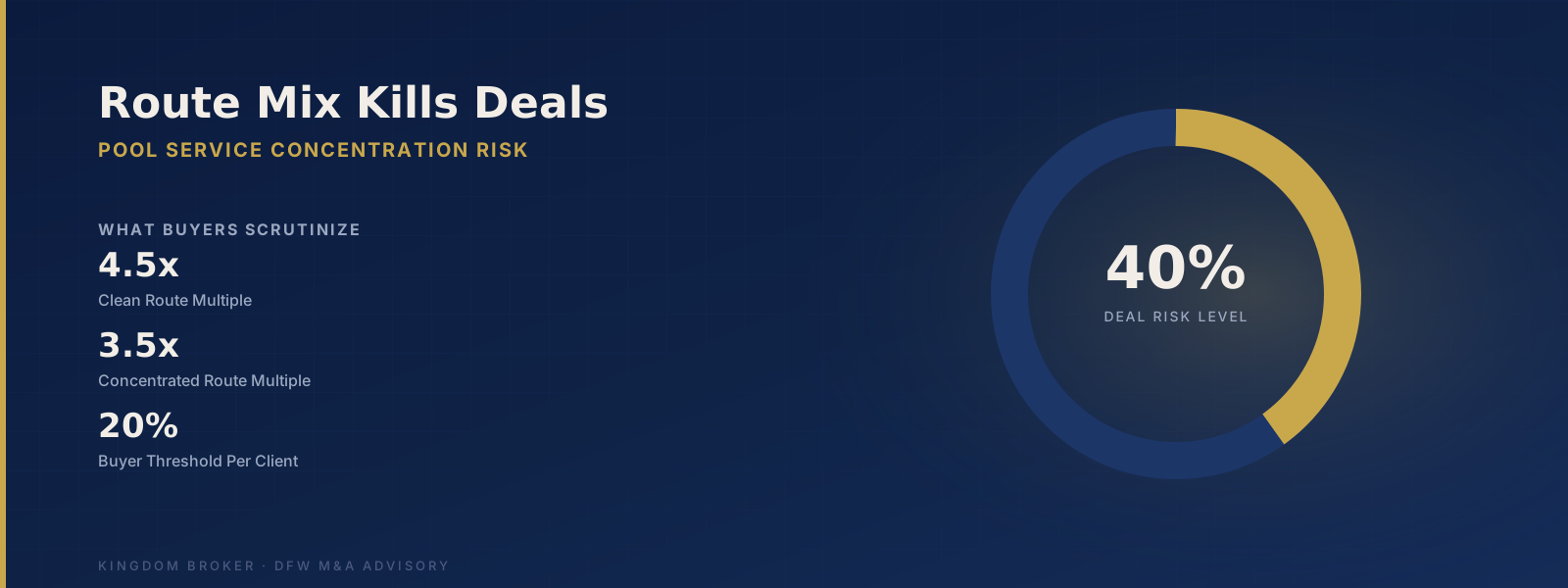
One HOA. One apartment portfolio. One commercial property manager. Forty percent of your revenue — sitting on a single annual contract that renews every January and can be canceled with 30 days' notice.
Deal paused. Sometimes deal dead.
This is pool service customer concentration. It's the single most overlooked value killer in the DFW pool market right now. And if you're planning to sell in the next 12 to 24 months, it deserves more of your attention than almost anything else on your list.
Why Concentration Hits Pool Businesses Especially Hard
Pool service has a structure that naturally invites concentration. The residential side is beautifully diversified — 150 homeowners, each paying $200 a month, nobody worth more than 1% of your book. Lose one, you barely notice.
But somewhere along the way, most operators layer in commercial. An HOA with six pools signs on. A resort-style apartment complex in Allen or Prosper wants weekly service plus chemical programs. A property management company hands you 12 properties at once.
Revenue jumps. Margins look good. You feel like you've leveled up.
But from a buyer's perspective, you've just introduced a fragility that residential alone didn't have. That commercial account isn't sticky the way a homeowner is. It goes out to bid. The property manager gets replaced. The HOA board turns over. And if that contract walks out the door six months after closing, the buyer just watched their investment thesis evaporate.
Buyers know this. Their lenders know this even better. SBA underwriters — who fund the majority of pool service acquisitions under $5M — will flag any single customer above 15% to 20% of revenue and start asking hard questions. Much above 25%, and you may see loan conditions, price cuts, or earnout structures designed to protect against exactly this scenario.
This isn't just theory. It's what we see in actual DFW deals. If you want to understand how lenders evaluate these risks, our breakdown of SBA 7(a) loan requirements in Texas walks through the underwriting criteria that directly affect your deal structure.
What the Numbers Actually Look Like
Here's the honest framework buyers and their advisors use when evaluating route concentration:
- Under 10% per customer: Clean. No issue. Buyers feel comfortable.
- 10–20% single customer: Yellow flag. Buyers want contract terms, renewal history, and relationship context.
- 20–30% single customer: Orange flag. Expect deal structure adjustments — earnouts, price reductions, or rep-and-warranty language tied to retention.
- Above 30% single customer: Red flag. Some buyers walk entirely. Others discount the revenue significantly in their valuation model.
On multiples: a well-diversified DFW pool service business with $1.2M in EBITDA and clean residential route mix might fetch 4.5x to 5.5x. That same business with a single commercial account at 35% of revenue? Expect 3.5x to 4x — if the buyer doesn't restructure the deal entirely.
That spread is real money. On a $1M EBITDA business, fixing concentration before you sell could mean $500,000 to $1,000,000 more at closing. Not in theory. In actual wire transfers.
For a deeper look at how these dynamics affect overall valuation, see our full guide on customer concentration risk when selling a business.
Route Mix: The Detail Most Sellers Ignore
Customer concentration isn't only about individual accounts. It's also about route structure.
Buyers who know pool service — and the serious PE-backed acquirers in DFW absolutely know pool service — look at geographic concentration, service type concentration, and tech dependency.
Geographic concentration means your routes are all clustered in one ZIP code or one subdivision. One competing operator moves in, prices aggressively, and you're exposed. Buyers want to see spread — Plano and Garland and Arlington, not just Southlake.
Service type concentration means your revenue is 90% chemical-and-clean with no repair revenue. Or the flip — you're heavy repair with thin recurring route revenue. Buyers value recurring route revenue at a premium precisely because it's predictable. If your mix skews too hard one direction, expect questions.
Tech dependency is newer but growing. If one technician personally knows 60 customers by name, handles all their complaints, and drives the relationship — and that tech isn't you — you have a key-person problem that mirrors customer concentration. One departure and revenue walks with them.
We cover the broader version of this problem in our piece on owner dependency and business value. The same logic applies to technician dependency.
How to Fix It in the 12 Months Before You List
You can actually move the needle in 12 months. It takes intention, but it's very doable in the DFW market.
Grow residential to dilute commercial weight
This is the simplest lever. If commercial is 40% of revenue today and you grow residential by 30%, commercial falls to maybe 30% of a larger number. You didn't lose the account. You just diluted its weight. In a market like DFW — where new construction pools are being installed in Celina, Anna, and Princeton at a pace almost nowhere else in the country can match — organic residential growth is genuinely achievable.
Renegotiate commercial contracts to longer terms
A large commercial account on a three-year contract with auto-renewal is far less scary to a buyer than the same account on a month-to-month arrangement. Before you list, push your commercial relationships toward multi-year paper. Buyers will pay for certainty. Lenders will underwrite it differently too.
Add a second large commercial account
Sometimes the fix isn't shrinking one client — it's adding another. If your one HOA goes from 40% to 22% of revenue because you landed a second property management group, concentration math improves dramatically. Two clients each at 20% is still not ideal, but it's a different conversation than one at 40%.
Document relationship depth
If you can't diversify the revenue, at least document why the concentration isn't as risky as it looks. Long tenure. Personal relationships. Switching costs. Exclusive service access. Put this in a one-page summary that goes in your deal package alongside the financials. Buyers can't value what they can't see.
This connects directly to how you prepare your overall documentation. Our guide to preparing your business for sale covers what smart sellers have ready before they ever talk to a buyer.
What Buyers in DFW Are Actually Paying Right Now
The DFW pool service market in 2026 remains one of the most active acquisition environments in the country. Year-round swim season. Population growth driving new pool installs. Private equity continuing to roll up regional operators.
But the buyers who are writing big checks — the PE-backed platforms and the experienced strategic acquirers — are disciplined. They've been burned before. They've bought businesses where a commercial account walked 90 days after close and suddenly their model was underwater.
They're not avoiding pool service. They're avoiding risk they can't underwrite. And customer concentration is the risk they can quantify most cleanly.
A diversified DFW pool service operator doing $800K to $1.5M in owner earnings, with clean route mix and no single customer above 12% of revenue, is as acquirable a business as exists in the lower-middle market right now. Those businesses get multiple offers. They close above initial ask. The sellers leave with legacy money.
The ones with concentrated commercial books? They still sell. But they leave money on the table — or they take structure risk (earnouts, escrow holdbacks) that a cleaner business never faces.
If you want to understand your current position, our free valuation tool will show you where you stand and what concentration is doing to your number right now.
Find Out What Concentration Is Costing You
Run your free valuation and see exactly how your customer mix is affecting your number before you ever talk to a buyer.
Get Your Free Valuation