How to Sell an HVAC Business in Frisco, TX
Frisco is one of the fastest-growing cities in the entire country. That's not a marketing line — it's a census fact. And for an HVAC business owner sitting on a route in Collin County, that growth corridor is either your biggest asset or the reason you're burning out trying to keep up with demand.
Either way, if you're thinking about selling, you picked a good market to exit in.
This is the full playbook. We'll cover what Frisco buyers actually want, how multiples shake out in 2026, what kills deals in the North Dallas corridor, and how to position your business before you ever take a call from a buyer.
Why Frisco Is a Seller's Market for HVAC Right Now
Frisco added tens of thousands of new residents over the last decade. Those residents live in homes that need HVAC systems — and they need service contracts, tune-ups, replacements, and emergency calls at 2 a.m. in July when it's 103 degrees and the upstairs unit dies.
New construction is still churning in the Legacy West corridor, Panther Creek, and the neighborhoods pushing north toward Prosper and Celina. That means new installs today become service accounts tomorrow. Buyers — especially private equity-backed platforms rolling up home services — see Frisco zip codes as premium real estate for a reason.
There's also a demographic tailwind. Frisco homeowners skew younger, higher-income, and more likely to pay for maintenance agreements than to DIY a refrigerant charge. That's the profile buyers price up.
So the demand side is real. The question is whether your business is positioned to capture top dollar — or whether you're leaving 30, 40, even 50 percent of your potential exit value on the table.
What an HVAC Business in Frisco Is Actually Worth
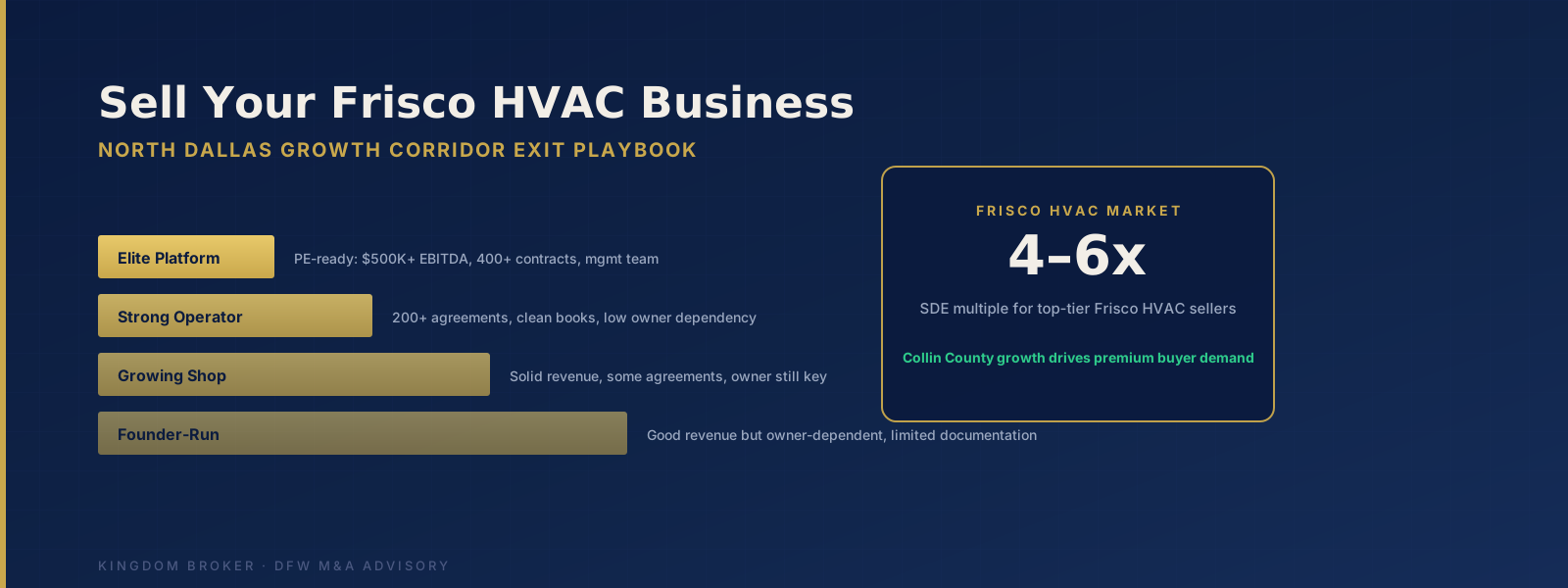
Let's be honest about multiples. In the DFW lower-middle market — businesses doing $1M to $20M in revenue — HVAC companies typically trade at 3x to 6x Seller's Discretionary Earnings (SDE) or 4x to 7x EBITDA depending on size and quality.
Frisco businesses can earn a premium inside those ranges. Here's why that range is so wide, and where you land in it:
- Recurring revenue — Maintenance agreements and service contracts are the single biggest multiple driver. A business with 400+ active contracts commands meaningfully more than one without.
- Owner dependency — If every tech call flows through you, if you're the one building customer relationships, if the business stops when you stop, buyers discount hard. See our piece on how owner dependency kills business value.
- Customer concentration — One big property management group or builder relationship making up 30%+ of revenue is a red flag. Buyers see that as risk, not opportunity. We break this down in detail in our customer concentration guide.
- Clean financials — Three years of organized P&Ls, documented add-backs, and a clear story about SDE. The sloppier the books, the lower the offer — or no offer at all.
- Technician capacity — Frisco is tight on labor. If you've built a stable, trained crew, that's transferable value. If you're constantly short-staffed, buyers see a liability.
A $3M revenue HVAC business in Frisco with 350 maintenance agreements, a 5-person tech team, and clean books can realistically exit at $1.2M to $1.8M. Without the agreements and with owner-dependent operations, that same revenue might only fetch $700K to $900K.
That gap is your preparation window.
Who Is Buying HVAC Businesses in Frisco Right Now
The buyer pool for a Frisco HVAC business in 2026 breaks into three main groups.
Private Equity-Backed Platforms
PE rollups are aggressive in the DFW market. They want businesses with $500K+ in EBITDA, recurring revenue, and a management layer that can run without the founder. Frisco's growth story makes it a target geography. These buyers move fast, pay at or above market, and often want you to stay involved for 12–24 months during transition. If you want to know what PE buyers specifically look for, this article goes deep on that.
Strategic Buyers (Other HVAC Operators)
A larger HVAC operator from Dallas, Plano, or McKinney might want your Frisco routes, your customer list, and your technicians. They often pay less than PE on a multiple basis, but deals can close faster and require less documentation. Sometimes the right fit is a neighbor who wants to stop competing with you.
Individual Buyers / Search Fund Operators
First-time business buyers — often backed by SBA 7(a) loans — are active in this space. They're buying jobs as much as businesses, and they can be excellent buyers if the deal is structured right. SBA financing for Texas buyers has specific requirements that affect your deal structure, so it's worth understanding before you get to the table.
The Frisco-Specific Factors That Move Your Multiple
Most valuation advice is generic. Here's what's specific to Frisco and the North Dallas growth corridor.
New Construction Service Contracts
If you've built relationships with builders in Frisco, Prosper, or Little Elm, those new construction contracts are a double-edged sword. Buyers love the revenue — but they want to see that it converts to service relationships, not just one-time installs. Document your install-to-service-agreement conversion rate. That number tells a story worth telling.
Geographic Density
Frisco routes are valuable partly because the homes are dense and the neighborhoods are new. But if your service area bleeds into Denton, Garland, and Rockwall with no coherent logic, buyers see dispatch inefficiency. Tight, defensible geography in Collin County commands a premium.
Seasonality Documentation
North Texas summers are brutal. Your Q2 and Q3 numbers probably look great. But buyers want to see how the business performs in January. Show them three years of monthly revenue, not just annual totals. It builds confidence and closes the gap on valuation.
How to Prepare Before You Go to Market
The single highest-ROI move you can make as a Frisco HVAC owner is to spend 6–12 months cleaning up your business before you take a call from a buyer. Most owners who sell fast and regret it skipped this step.
Start with your financials. Three years of clean P&Ls, documented owner add-backs, and a clear SDE calculation. If you're not sure what an add-back is or why it matters, read this first.
Then attack owner dependency. Document your processes. Empower your lead tech or service manager to handle customer relationships. Make yourself optional in day-to-day operations. Every month you spend doing this before going to market adds real dollars to your exit.
And get your maintenance agreement numbers clean. Total active agreements. Monthly recurring revenue from those agreements. Renewal rate. Churn rate. Buyers will ask for all of it. Having the answers ready signals professionalism — and signals that there's a real business here, not just a truck and a phone number.
Our full business sale preparation guide walks through every step in detail.
Timeline and What to Expect
A well-prepared HVAC business sale in Frisco typically takes 6 to 12 months from first conversation to closed deal. Here's the honest breakdown:
Preparation and packaging takes 4–8 weeks if your books are reasonably clean. Going to market and running a process — fielding IOIs, getting to LOI — typically takes 60 to 120 days. Due diligence and financing (especially with SBA buyers) adds another 60 to 90 days. Then closing.
Sellers who try to rush this — who call a buyer Monday and expect a check by Friday — usually end up with bad deals or no deals. The market rewards patience and preparation.
If timing matters to you, here's our read on market timing in 2026 specifically.
One Final Truth About Frisco
The growth corridor along the Dallas North Tollway isn't slowing down. The buyers who want a foothold in Frisco know that. The window to command a premium multiple in this geography is open — but it won't stay open forever as more sellers come to market and buyer competition evolves.
If you've built something real in Frisco — real customers, real recurring revenue, real techs who show up — you deserve to exit at a number that reflects that.
The question is whether you're going to let the process extract that value, or leave it behind.
Find Out What Your Frisco HVAC Business Is Worth
Get a free, no-obligation valuation from a DFW M&A advisor who knows the Collin County market. You built something real — let's find out what it's worth.
Get Your Free Valuation